

What Is Generative Engine Optimization and Why It Matters in 2026
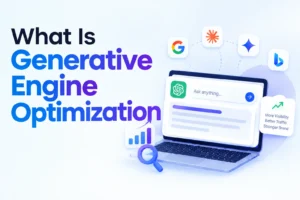
Today, users have abandoned the traditional methods to get search results or find any information. Instead, they rely on various Generative Engine Optimization tools such as ChatGPT, Google AI Overviews, Grok and Perplexity. This has changed the nature of finding information indefinitely. With generative AI SEO, people can search for various brands, products, and services.
Now, the users get instantly organized results on the very first page. Previously, they had to scroll through pages to find relevant information. They needed to compare the results, check the right answers, and still feel doubtful.
Unlike the conventional methods, businesses need to adapt to this new technique to stay relevant in the cut-throat competition. Implementing GEO is not an option anymore; it has become a necessity in this AI-powered search era.
What Is GEO – Generative Engine Optimization?
Generative Engine Optimization (GEO) is the process of creating and optimizing the content so that the AI-based platforms can understand, trust, and use for creating responses to relevant queries.
GEO, in the modern era, helps brands, products, or services appear when users upon searching via AI-generated results.
While SEO helps improve ranking on SERPs, Generative AI SEO is useful in making the content trustworthy and valuable to show in AI-generated responses.
Compared to standard search methods, users are now relying on this new AI-powered search method to get results.
Let’s understand this with an example:
“What should I do to improve my page views on a newly created website?”
Generative AI will visit multiple online sources and find the perfect matching answer to the above query by the user.
It saves time and effort for the user to get an accurate answer compared to the traditional search method, which confuses users many times.
The users get optimized and accurate answers to their queries with proper subheadings, meta, images, and so on to make it more appealing.
Why GEO Matters for Modern Brands in 2026
AI-powered search results are evolving faster than before, According to Google AI Overview, AI-generated summaries are transforming how users interact with search results.
Now, the search engines act like answer engines, showing results instead of a list of webpages to the users. Users get a summarized and detailed answer to their queries effortlessly and quickly. The responses they get are also accurate and reliable.
In such changing times, what will happen if you do not adapt your answer engine optimization?
There are various consequences of not adapting to the current trend, such as:
- Low organic Traffic
- Low digital visibility
- Reducing engagement
- Few or low brand mentions
However, if the businesses take GEO seriously and implement it, they can increase their online visibility, optimize their position, and show themselves as a trusted and reliable source within the AI ecosystem.
Unlike before, ranking on the first page has become optional for many businesses. Now they find being considered in AI-generated responses more valuable and profitable.
GEO vs SEO Comparison
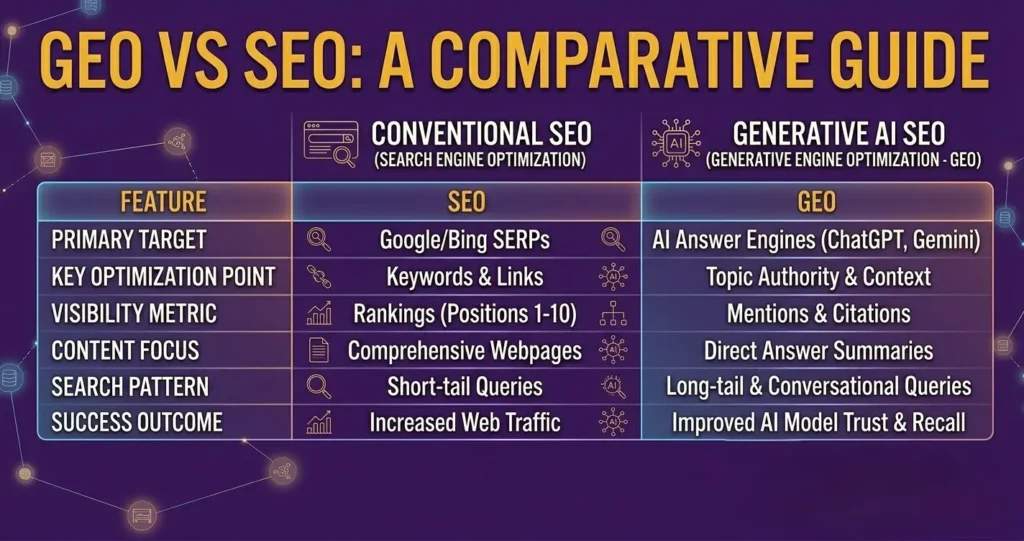
Some may confuse SEO vs GEO as one, but there is a difference between the two. Both have their pros and cons. Although the main focus of both strategies is to improve online visibility, their optimization techniques are different.
Let us also understand with the example below. If the user searches for “what are the steps involved in On-page SEO. The generative AI will visit various sites and will gather accurate results as per the search query.
Upon clicking show more, the user will have the accurate and indepth details of the query they asked.
While in traditional SEO, the SERP used to show the website that offered the answer to the question, not the answer itself.
| SEO | GEO |
| Main focus on improving search engine rankings | Main focus on AI-generated results. |
| SEO optimizations lead to more traffic and clicks. | GEO Optimization leads to mentions and citations in AI results. |
| Keyword-driven | Context and intent-driven |
| Targets SERPs | Targets AI answer engines |
| Measures rankings | Measures AI presence and authority |
GEO also does not imply that SEO is not important; it is still important, but now accompanied by GEO techniques.
Thus, in 2026, to achieve success, digital marketing needs to focus on SEO, AEO, AI search optimization altogether To understand how AI is changing search visibility, you can also read our guide on AI SEO strategies for 2026.
How Generative AI SEO Works
To get discovered, the business now has to work hard to think and move beyond traditional SEO. They are now compelled to create original content that answers the user’s query. The more users get the content recommended to them by AI, the more chances of their visibility and trustworthiness.
Key Strategies for Effective AI Search Optimization
1. Create Human-Centered Content
The creators must draft content written for the people who answer their questions and solve their problems. It must provide valuable insights and must be written by a human, as it performs better in AI SEO.
2. Improve Content Structure
Many might ignore this, but improving the structure helps in AI optimisation. For that, keep clear headings, short paragraphs, an easy readability score, bullet points, an FAQ section for quick, short questions, etc.
3. Strengthen EEAT Signals
EEAT stands for: Experience, Expertise, Authoritativeness, and Trustworthiness. All these are highly important for both SEO and GEO. With the massive adoption of AI-assisted search models, the global usage has reached 56% of traditional search engine volume. It continues to accelerate globally.
4. Optimize for Conversational Queries
The user search behavior has evolved in 2026; instead of searching for the “best SEO tools”, they now elaborate the search like “what are the best SEO tools for newbies in 2026?”
Content must answer these types of long, conversational queries.
5. Focus on Topical Authority
Brands must not publish on random topicsThis is similar to how a strong on-page and off-page SEO strategy builds long-term authority.; rather, their topics must center on their core product or service, thereby building topical authority. The deeper your expertise around the topic, the more the chances of AI visibility.
The Future of AI Visibility Optimization
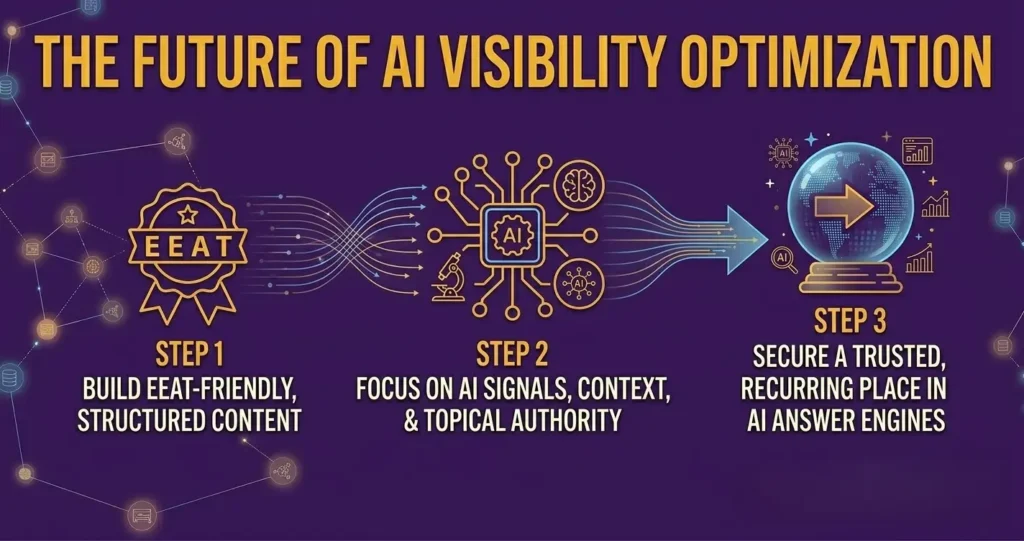
AI-generated search experiences are going to grow rapidly in the coming years, and that is why businesses need to focus not only on Google’s search engine but also on AI signals.
AI visibility optimization is becoming the core part of any digital marketing strategy. Therefore, brands must now focus on creating the EEAT-friendly content, which is well-structured and written with the expertise of the subject.
Final Thoughts
It is very crucial to understand what Generative Engine optimization is and why it matters the most in 2026. It helps brands to stay ahead in the evolving digital world.
The AI-powered search experience is reshaping how users interact with brands, how they discover brands, and above all, what factors motivate them to make any decision.
In 2026, success is not defined by whether you are ranking high or not, but rather by whether AI platforms trust you enough to recommend?
Frequently Asked Questions
Want to rank in AI-generated answers and not lose leads to competitors?
Get a free AI SEO audit from IQRA Digital Solutions and discover how to improve your Generative Engine Optimization strategy.
What is Generative Engine Optimization (GEO)?
Generative Engine Optimization, also known as GEO, is the process of optimizing the content for AI-powered search engines. For those platforms that summarise the query of the user and generate a response for the user by studying various websites.
What is the major difference between GEO and SEO?
The main difference between the GEO and SEO is that SEO’s main focus is on improving the Search rankings on the SERP. At the same time, GEO focuses on increasing the visibility of AI-generated answers in conversational platforms.
Why is AI search optimization important in 2026?
With the changing patterns in user search, it is important to stay visible in AI-generated responses. During the year 2025, the global search traffic was around 15.6 billion visits, which grew to 27 billion visits in 2026 with a massive 42.8% YoY growth rate. Therefore, AI search optimization is important.
How does Generative AI SEO help brands and businesses?
Generative AI SEO helps in improving brand visibility across AI-powered search results on various search engines, which further helps businesses in building trust and gaining authority.
Can GEO replace traditional SEO?
This is the most asked question, but the answer is no. Any businesses or brands will need traditional SEO for rankings and GEO for higher visibility to achieve success in 2026.