

Local SEO Checklist for Small Businesses in Navi Mumbai
Table of Contents
You run a good business. Your work is solid, your customers are happy, and yet someone two lanes away searches “clinic near me” and finds your competitor first.
This local SEO checklist is written to fix exactly that. It walks through the steps that help nearby customers find you on Google Search and Google Maps, in plain language and in a sensible order. It is made for owners of shops, clinics, restaurants, coaching classes, factories and service businesses across Navi Mumbai. You do not need to know SEO to follow it.
One honest note before we begin: no checklist can promise a Google ranking. What it can do is help you set things up properly and avoid the mistakes that quietly hold small businesses back.
What Is Local SEO?
Local SEO means making your business easier to find when people search for something nearby. It covers your Google Business Profile (the listing that appears on Google Maps), your website, your reviews and the business details that appear around the web.
Here is a simple example. Someone in Nerul types “child specialist near Nerul station”. Google shows a map with three or four clinics, each with ratings, a phone number and directions. Those results come from local search. A clinic that has a complete, accurate profile and genuine reviews has a better chance of being among them.
Regular SEO helps your website show up in general search results. Local SEO is focused on the person standing in Vashi, Kharghar or Airoli who needs something today. If you want a quick refresher on SEO itself, our guide on what search engine optimisation is and how it works covers the basics.
Why Is Local SEO Important for Businesses in Navi Mumbai?
Navi Mumbai is a busy, spread-out market. Many nodes have their own shops, clinics, schools and offices, and customers rarely travel far for everyday needs. They search, compare two or three options and call. Local SEO helps you be one of those options.
Done well, it can help you:
- Reach people who are searching for nearby services right now.
- Appear more often in Google Maps discovery.
- Make sure customers see the right phone number, address and hours.
- Get more relevant calls, website visits and direction requests.
- Build trust through genuine customer reviews.
- Stay visible in crowded areas like Vashi, where many similar businesses sit close together.
Visibility is not the same as sales. A call or a profile view is a chance, not a customer. Your service, pricing and how you answer the phone still decide the outcome.
How Does Google Decide Which Local Businesses to Show?
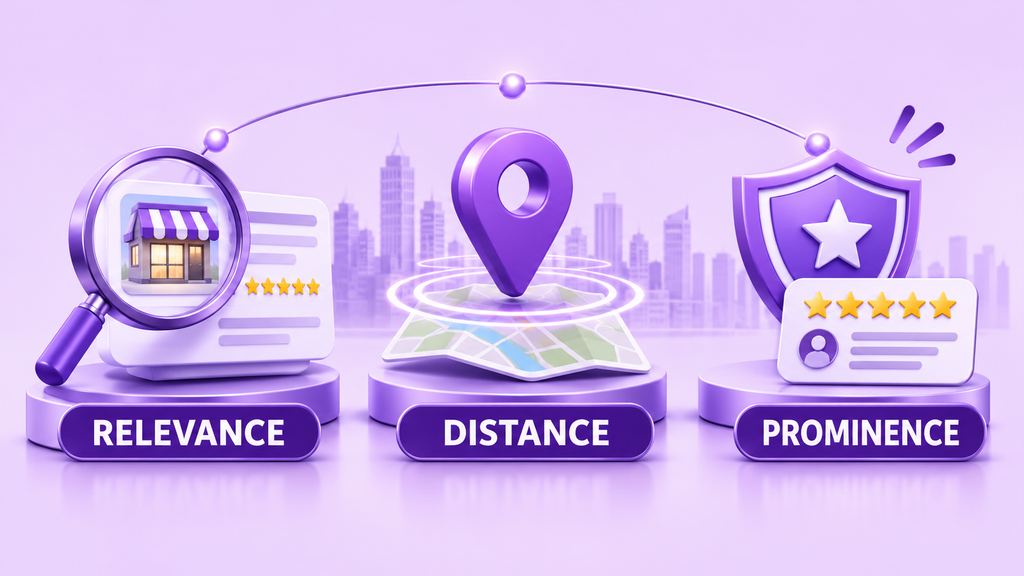
Google’s own help page says local results are mainly based on three things: relevance, distance and prominence. You can read it in Google’s guide to improving your local ranking.
Relevance is how well your business matches what the person searched for. If your profile says “dental clinic” and someone searches for a dentist, you are relevant. A profile with vague or wrong categories is harder for Google to match.
Distance is how far your business is from the searcher, or from the area they mentioned. A restaurant in Sanpada has a natural advantage for someone standing in Sanpada. You cannot control where the customer is, and that is fine. Accurate address details simply let Google work out the distance correctly.
Prominence is how well known and trusted your business is. Reviews, mentions on other websites, your website quality and your overall reputation all play a part.
Here is how it plays out. A coaching institute in Airoli and another in Ghansoli both show up for “IIT coaching near Airoli”. The one that is closer, describes its courses clearly and has more genuine reviews will usually be favoured. Even so, nobody can guarantee a Maps position, and anyone who does is not being honest.
Complete Local SEO Checklist for Small Businesses
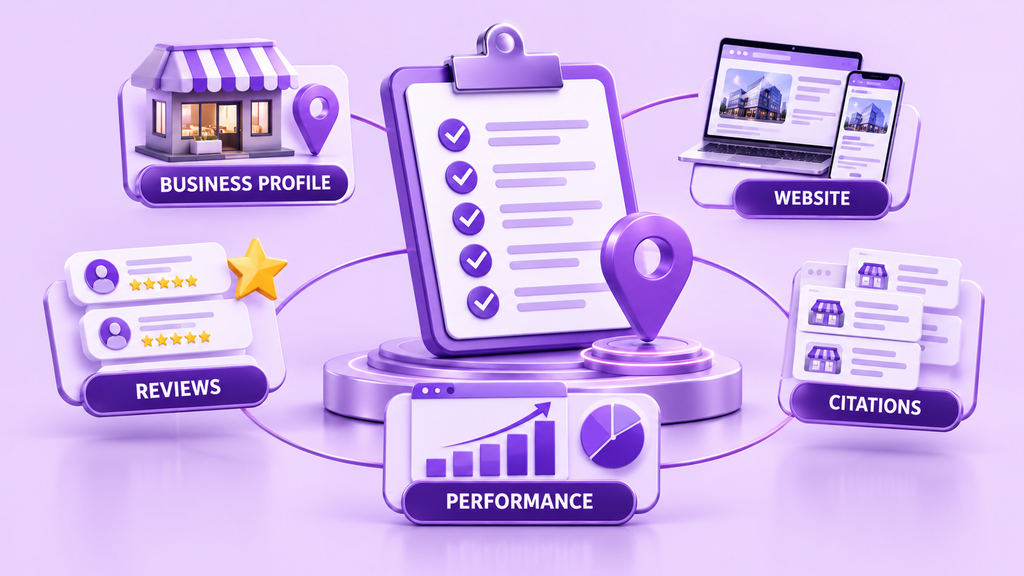
Work through these fifteen steps in order. If you are short on time, the first two steps matter most. Tick off what you have already done and focus on the gaps.
1. Set Up and Verify Your Google Business Profile
Your Google Business Profile (GBP) is the free listing that shows your business on Maps and Search. Start here.
- Search for your business first. If a profile exists, claim it. Do not create a second one.
- Complete Google’s verification so you can manage the profile.
- Use your real business name, exactly as it appears on your signboard and visiting card.
- Choose the most accurate primary category, such as “Dental clinic” rather than “Health”. Add secondary categories only if they truly describe what you do.
- Enter your correct address, or your service area if you travel to customers.
- Add a working phone number and your official website.
- Set accurate opening hours, and add relevant attributes such as wheelchair access or home delivery.
There are two types of business. A premises-based business serves customers at its location, like a restaurant in Vashi. A service-area business goes to the customer, like an AC repair or home cleaning service. Service-area businesses can hide their address and list the areas they serve, but only areas they genuinely cover.
Please avoid fake addresses, virtual offices used to pretend you are somewhere you are not, and extra profiles for the same business. Google’s guidelines for representing your business say profiles should reflect the real-world location, and breaking them can get a profile suspended.
What we learned on our own profile. IQRA’s own profile needed cleaning up. The mobile number had to be corrected, and the service locations had earlier included the USA and Dubai, which did not reflect how we actually work. We reviewed the details and gradually aligned them with the real business. We cannot say these fixes alone changed a ranking. What we can say is that a wrong number or a wrong service area sends customers to a dead end, and that is reason enough to fix it. You can see our public profile here.
2. Optimize Your Google Business Profile
A verified profile is only the starting line. Now make it useful.
- Write a clear description of what you do, who you serve and where. Write for customers, not for Google.
- Add your real services and products with short, honest descriptions.
- Upload genuine photos of your shop, team, work and products. Skip stock images.
- Keep hours updated, including festival and holiday timings.
- Post updates when you have something worth sharing, like a new service or an offer.
- Answer customer questions where that feature is available.
- Check your profile every so often. Customers and other users can suggest edits, and sometimes wrong details slip in.
Do not stuff keywords into your business name, for example “Sharma Dental Clinic Best Dentist Vashi”. It breaks Google’s guidelines and can get your profile edited or suspended. Put your keywords in the description and services, in natural sentences.
3. Choose the Right Local Keywords
A keyword is simply a phrase people type into Google. Local keywords usually combine what you do with where you are.
Start by listing how your customers would ask for you. Some realistic examples:
- A property consultant in Kharghar: “flats for sale in Kharghar”, “property consultant Kharghar”.
- A clinic in Nerul: “skin doctor in Nerul”, “clinic near Nerul station”.
- A coaching centre in Airoli: “NEET coaching Airoli”.
- A restaurant in Vashi: “family restaurant in Vashi”.
Also notice the intent. “How to choose a skin doctor” is someone learning. “Skin specialist in Nerul open now” is someone ready to call. Service pages and your Google profile should target the second type, while blog posts can answer the first.
Match each keyword to one page. Do not create a separate page for every tiny variation such as “best”, “top” and “affordable”. One strong page is better than five thin ones.
4. Optimize Your Website for Local Searches
Your website supports your profile. Google looks at both to understand what you do and where.
- Mention your actual location where it fits, such as in the contact page, footer and service pages.
- Create a clear page for each main service.
- Write a page title and a short description that tell people what the page is about. These appear in search results.
- Use one main heading (H1) per page, then smaller headings (H2, H3) in a logical order.
- Add real photos with simple descriptions in the alt text, which helps screen readers and search engines.
- Make your phone number, address and enquiry options easy to find.
- Link related pages to each other in a natural way.
If your site is outdated or hard to update, a website built with SEO and speed in mind makes all of this easier.
5. Create Useful Location-Specific Pages
A location page makes sense when you genuinely serve that area and have something useful to say about it.
Imagine an interior designer based in Vashi who regularly works in Vashi and Nerul. A page for each area could show projects done there, typical requirements, travel and visit details, and a contact option. A visitor in Nerul instantly understands that you work in their area.
What does not work is copying one page 25 times and changing only the locality name. Google calls pages like that doorway or thin content, and they do not help readers. Create a location page only if you can fill it with facts, examples and details that are specific to that area.
And please do not add every Navi Mumbai locality to your Google Business Profile service area hoping for more rankings. List only the areas you really serve.
6. Keep Your Business Information Consistent (NAP)
NAP stands for Name, Address and Phone number. Consistency means these three details are written the same way everywhere: your website, Google profile, social pages, directories and local listings.
Here is why it matters. Suppose a Turbhe manufacturer is “Shree Metal Works” on Google, “Shree Metals” on a directory and has an old phone number on Facebook. A buyer may call the dead number and give up. Search engines also find it harder to be confident about which details are correct.
Make one master note with your exact business name, address format and primary phone number. Use it whenever you create or update a listing.
7. Get Genuine Customer Reviews
Reviews help people decide, and they support your prominence. But how you collect them matters.
- Ask real customers, after a real experience, for honest feedback.
- Make it easy by sharing your Google review link on WhatsApp or in the bill.
- Reply to positive reviews with a short, personal thank you.
- Reply to negative reviews calmly. Thank them, address the issue, and offer to talk offline. Never argue.
- Do not buy reviews, and do not offer gifts or discounts in return for positive ones.
- Do not ask only your happiest customers to review while avoiding the rest.
Google has clear rules about fake and incentivised reviews, and violations can lead to removal of reviews or profile penalties. Even a perfect review routine cannot guarantee a ranking, but it builds trust you can’t fake. Our article on how E-E-A-T builds trust and visibility explains why trust signals matter.
8. Build Relevant Local Citations
A local citation is a mention of your business name, address and phone number on another website, usually a business directory.
Focus on quality, not quantity:
- Well-known directories used in India that match your business.
- Industry-specific listings, such as healthcare, education or property portals.
- Local business associations and chambers.
- Trusted regional directories.
Always use the same details from your master note. Skip bulk submission to hundreds of low-quality directories. Those add little value and can create messy, inconsistent listings that you have to clean up later.
9. Earn Relevant Local Backlinks
A backlink is a link from another website to yours. It works like a recommendation, so quality matters more than count.
Legitimate ways small businesses can earn them:
- Partnerships with other local businesses, for example a gym and a nutritionist in Kharghar.
- Membership pages of industry or trade associations.
- Sponsoring or taking part in local events and community activities.
- Genuine features in local news or business blogs.
- Useful resources, such as a local area guide, that others may want to reference.
Avoid paid link packages, link farms and “1,000 backlinks for ₹2,000” offers. They can harm your site. Our guide to on-page and off-page SEO explains how links fit into the bigger picture.
10. Make Your Website Mobile-Friendly and Fast
Most local searches happen on phones. A customer standing outside a mall in Seawoods will not wait for a slow, cluttered website.
Check that:
- Text is easy to read without zooming.
- A tap-to-call button and your address are visible near the top.
- Menus are simple.
- Pages load quickly, and images are sized properly.
- Your enquiry form works and actually reaches you. Test it yourself.
- The site uses HTTPS (the padlock sign).
Open your own site on your phone today. If you get frustrated, your customers do too.
11. Add Local Business Structured Data
Structured data is extra information added behind the scenes of your page so search engines understand it better. For local businesses, this is usually LocalBusiness structured data, which can describe your business name, address, phone number, website, opening hours and type of business.
Google explains the format in its LocalBusiness structured data documentation. Make sure everything in it matches what is visible on your page and on your profile. Structured data does not automatically improve rankings, and it does not guarantee special results in search. Think of it as a clean label, not a booster. A developer or SEO professional can add and test it for you.
12. Improve Internal Linking
Internal links are links between pages on your own website. They help visitors move to the next useful page, and they help search engines discover and understand your pages.
For example, a blog post about Google Business Profile tips can link to your Local SEO service page. A location page can link to the relevant service page, and a service page can link back to the useful guide. Use descriptive anchor text like “Local SEO services in Navi Mumbai” instead of “click here”.
13. Check Local Competitors
Search for your main service the way a customer would, in the area you want to be found. Look at the businesses in the top results and note:
- Which categories and services they list.
- How complete their profile and photos are.
- How many reviews they have, and how they respond.
- What pages and information their websites offer.
The goal is to spot gaps and opportunities. Perhaps nobody in your area explains pricing clearly, or no one has good photos. Learn from what you see but never copy their content or details.
14. Track Your Local SEO Performance
What gets checked gets improved. Two free tools do most of the job: your Google Business Profile performance report and Google Search Console.
In your profile report, look at calls, website clicks, direction requests and total interactions. In Search Console, look at impressions (how often your site appeared), clicks and the search queries bringing people in. Also keep a simple note of the enquiries you actually receive.
Remember that a click or a call is not a confirmed customer. For perspective, our own profile’s Google reporting from June to November 2026 showed 2,244 total interactions and 957 calls (the November period was incomplete), with 268 interactions and about 180 calls in September. These are profile activity numbers. They do not tell us how many calls became clients, and we would not claim they do.
15. Review and Update Your Local SEO Regularly
Local SEO is not a one-time setup. Hours change, services are added, new competitors open and old photos age. Make a habit of checking your hours, photos, services, website details, reviews and performance numbers. The schedule later in this guide shows how.
Common Local SEO Mistakes Small Businesses Should Avoid
- Wrong primary category. Pick the one that best describes your main business, and add secondary ones only if needed.
- Old phone numbers or incorrect details. Audit your profile, website and listings, then fix them.
- Keywords in the business name. Use your real name. Put keywords in descriptions and services.
- Duplicate profiles. Find and merge or remove them through Google’s process.
- Fake or misleading addresses. Use your real location, or switch to a service-area setup.
- Buying fake reviews. Ask real customers instead.
- Duplicate or thin location pages. Create fewer pages and make each one genuinely useful.
- Ignoring negative reviews. Reply politely, take the issue seriously and fix it.
- Irrelevant backlinks. Choose relevant local links over cheap bulk links. Our overview of white hat SEO explains why shortcuts backfire.
- Neglecting the mobile website. Test on your own phone every month.
- Never checking performance. Set a monthly reminder.
- Expecting instant rankings. Local SEO builds over time. Focus on steady improvements.
A Real Example of Google Business Profile Optimization by IQRA
This example is from Raipur, not Navi Mumbai. It is a spa business client, and we are sharing it as an example of our practical Google Business Profile work.
The challenge. The spa’s profile was not representing the business accurately. Categories, target location, business type and service details needed attention.
What we did.
- Optimized the Google Business Profile categories.
- Corrected the target location.
- Improved the business description.
- Optimized products and services.
- Corrected the business type.
- Managed the profile overall and replied professionally to both positive and negative reviews.
The reviews came from real customers after their visits. We did not create any. We only helped manage the responses.
Reported observations.
| Metric | Reported monthly values | What it shows |
|---|---|---|
| Calls | August – 686, September – 733, October – 696 | Stayed around 700; first and latest values about 1.5% apart |
| WhatsApp chat clicks | August- 167, September – 180, October – 189 | Rose about 13.2% from first to latest |
| Website clicks | August – 80, September – 100, October – 120, | Rose about 87.5% from first to latest |
These are reported monthly observations from the profile, not confirmed customers or sales, and we are not attributing every change to one action. Calls stayed steady, WhatsApp interest grew modestly, and website clicks grew the most.
What you can learn from it. An accurate profile gives customers several ways to reach you, not only by phone. Look at all your profile actions, such as calls, WhatsApp and website visits, instead of one number. And honest, steady work on the basics tends to matter more than tricks.
How Often Should You Work on Local SEO?
You do not need to do everything every week. Use this as a guide and skip tasks when there is nothing new.
Weekly
- Check for new reviews and respond to them.
- Look for wrong or unexpected changes to your business details.
- Post an update if you have something worth sharing.
Monthly
- Review profile performance (calls, website clicks, directions).
- Check key website pages and your contact details.
- Look at how you appear for your main local searches.
- Spot-check your details on important listings.
- Peek at what competitors are doing.
- Note any technical or content issues to fix.
Quarterly
- Review location pages and see if any need updating or merging.
- Recheck your categories and services.
- Revisit your keyword plan.
- Check website speed and technical health.
- Review your overall Local SEO plan.
When Should You Hire a Local SEO Agency?
Many owners can do the basics themselves. Professional help starts to make sense when:
- You are not showing up for relevant local searches despite doing the basics.
- Your profile has incorrect or incomplete information that you cannot fix.
- You manage several locations.
- Your website needs location pages.
- Technical problems affect your site.
- You do not have time for regular SEO work.
- You want a clear plan and regular reporting.
IQRA Digital Solutions is based in Vashi and works with businesses across Navi Mumbai. Our Local SEO services in Navi Mumbai can cover profile setup, category and service optimization, review response support, location pages, citations and technical checks. The scope and cost depend on your business and what needs to be done, so we start by understanding your situation. We do not promise rankings, because nobody honestly can.
Frequently Asked Questions About Local SEO
1. What is a Local SEO checklist?
It is a step-by-step list of actions that help a business appear in local search results, covering the Google profile, website, reviews, listings and tracking.
2. How can a small business improve its local SEO?
Start with an accurate, verified Google Business Profile, then improve your website, keep your details consistent, collect genuine reviews and check your performance regularly.
3. How do I improve my Google Maps ranking?
Focus on relevance, distance and prominence. Pick correct categories, complete your profile, get real reviews and keep information accurate. Distance depends on the searcher, and no ranking can be guaranteed.
4. Is Google Business Profile optimization important for Local SEO?
Yes. Your profile is often the first thing a nearby customer sees, so it should be accurate, complete and active.
5. How long does Local SEO take to show results?
It varies with your competition, starting point and effort. Some improvements appear sooner than others, but there is no fixed timeline, and it is ongoing work.
6. Do small businesses need a website for Local SEO?
A Google profile can bring calls without one, but a website gives you more to show, more to rank with and more trust. Most businesses benefit from having one.
7. How many reviews does a local business need?
There is no magic number. Aim for a steady flow of genuine reviews and look at what competitors in your area have as a reference.
8. What is NAP consistency in Local SEO?
It means your business Name, Address and Phone number are written the same way across your website, profile and listings.
9. Can a service-area business rank on Google Maps without showing its address?
It can appear, as Google lets eligible service-area businesses hide the address. Visibility still depends on relevance, distance and prominence, and nothing is guaranteed.
10. Is Local SEO useful for businesses in Navi Mumbai?
Yes, especially where many similar businesses sit close together. People here often search for nearby options before they call or visit.
Final Local SEO Checklist: What Should You Do First?
If you only have an hour this week, do these in order:
- ☐ Claim and verify your Google Business Profile.
- ☐ Correct your name, phone, address, hours and categories.
- ☐ Add real photos and a clear description and services.
- ☐ Ask recent, genuine customers for reviews and reply to existing ones.
- ☐ Make sure your website shows the same details and works well on mobile.
- ☐ Fix inconsistent listings.
- ☐ Set a monthly reminder to check performance.
Still unsure where to start, or short on time? You are welcome to explore our professional Local SEO support for Navi Mumbai businesses. We’re happy to take a look and tell you honestly what needs attention.
Read More:
E-E-A-T in SEO: How to Build Trust and Visibility
What Is Search Engine Optimisation (SEO)? An Easy Guide
On-Page and Off-Page SEO: Which Drives More Leads?
Written by the performance marketing team at IQRA Digital Solutions, their years of experience with SEO strategy and and digital marketing for B2B lead generation. LinkedIn