

WordPress vs Shopify: Best for Mumbai Businesses?
If you are planning a new website or a redesign, sooner or later you will face this question: WordPress or Shopify? Both are good platforms. Both power thousands of Indian businesses. But they are built for different jobs, and picking the wrong one can cost you time and money later.
The WordPress vs Shopify decision is not about which platform is “best”. It is about what your business needs right now and where you want to be in two or three years. A Mumbai manufacturer who wants to show a product range and collect enquiries has different needs from a D2C brand that wants to sell 300 products online.
In this guide, we compare the two on cost, SEO, design, e-commerce and maintenance. We also share what we have seen while moving two real businesses, MEDFY and Hatti Butti, from WordPress to Shopify. By the end, you should know which platform suits your situation.
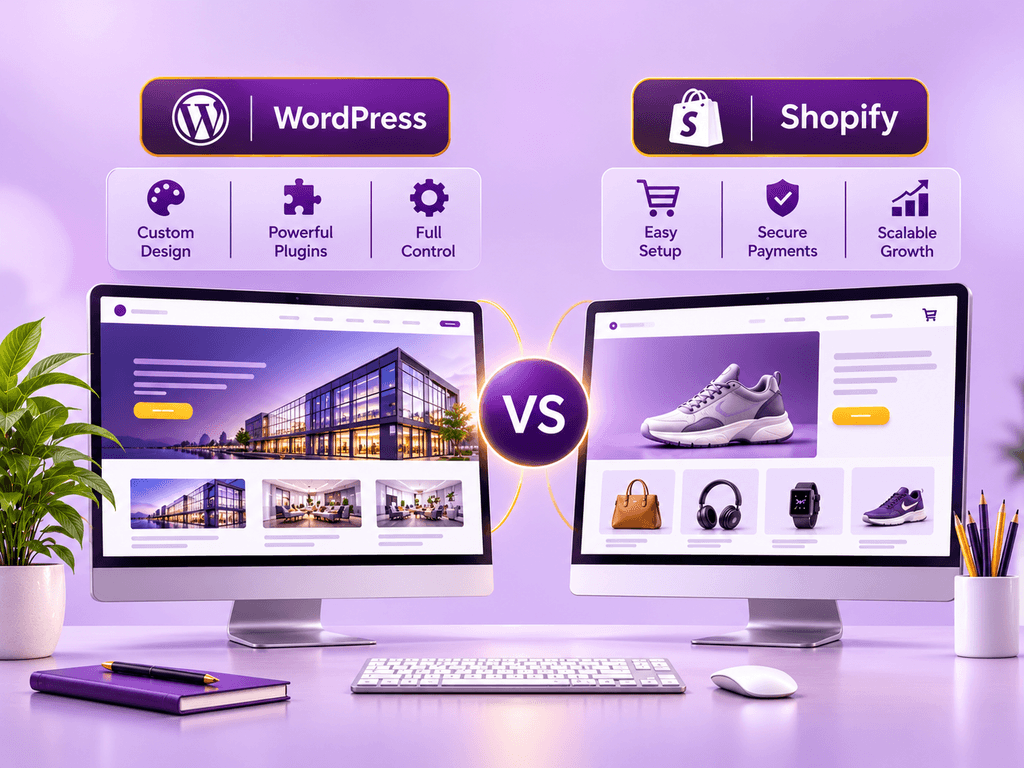
Understanding WordPress and Shopify
What Is WordPress?
WordPress is a free, open-source content management system. In simple words, it is software that lets you create and manage a website without writing code for every page. You install it on your own hosting. Hosting is the service that stores your website files and makes your website available online.
Businesses use WordPress for company websites, service websites, portfolios, blogs and news sites. You can add features through plugins. A plugin is an additional tool that adds a feature, such as a contact form, a booking system or an online payment option.
WordPress can also sell products through WooCommerce, an e-commerce add-on built for WordPress. The trade-off is that you get a lot of freedom, but you or your developer must handle hosting, updates, backups and security.
What Is Shopify?
Shopify is a hosted e-commerce platform. It gives you a ready-made system for selling products online, so you do not have to arrange your own hosting. You pay a monthly or yearly subscription to Shopify.
Inside the Shopify dashboard, you add products, manage stock, accept orders, set up payments and track shipping. Themes control the design, and apps add extra features. Because most of the technical base is managed by Shopify, many store owners find daily operations simpler.
The trade-off is that you work within Shopify’s structure. You get less freedom than WordPress, and apps can add to your monthly costs.
WordPress vs Shopify: Quick Comparison
| Factor | WordPress | Shopify |
|---|---|---|
| Best suited for | Corporate, service, content-led and custom websites | Product-focused online stores |
| Ease of use | Easy for content, but needs technical care | Easy for store management |
| Design flexibility | Very high | Good, within Shopify’s structure |
| SEO capabilities | Very flexible, depends on setup | Solid basics, fewer deep changes |
| E-commerce features | Through WooCommerce and plugins | Built in |
| Hosting | You arrange it separately | Included with the subscription |
| Maintenance | Updates, backups, security checks needed | Platform maintained by Shopify; you manage store and access |
| IQRA starting development price | ₹15,000 | ₹25,000 |
| Recurring costs | Hosting, premium plugins, maintenance | Shopify subscription, apps, theme if paid |
| Scalability | Scales with good hosting and development | Scales well for growing product catalogues |
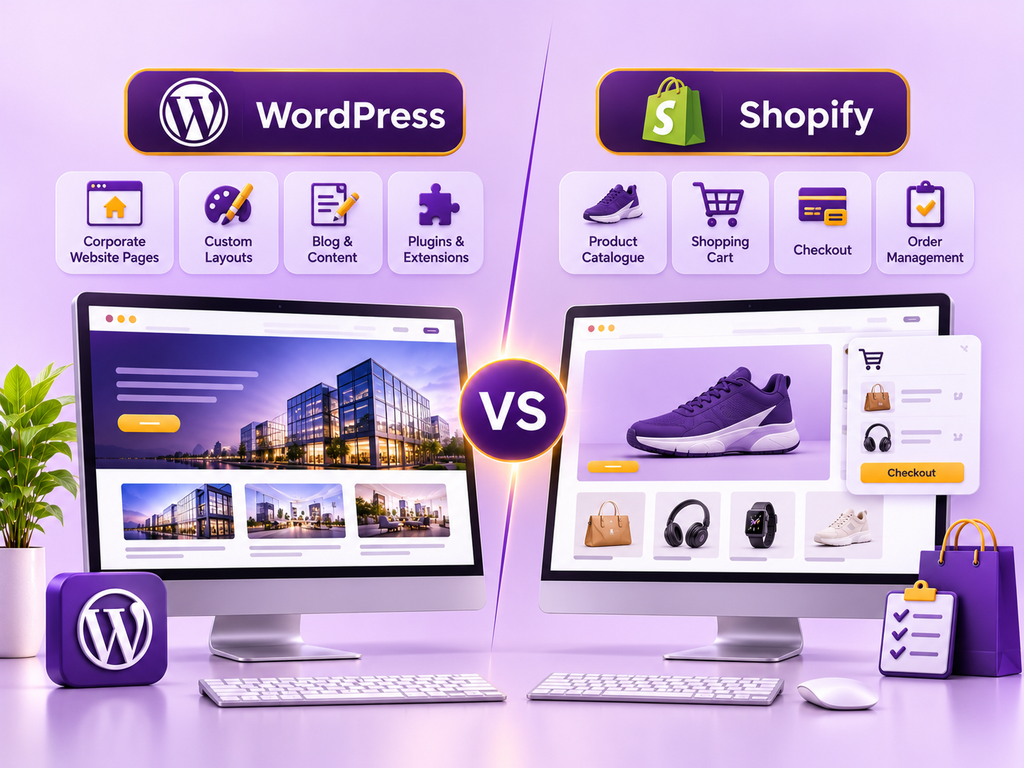
The IQRA prices above are starting development charges only. They are not the total cost of owning a website. We explain the difference in the cost section below.
WordPress vs Shopify: 8 Important Differences
Ease of Use
For writing blog posts or editing service pages, WordPress is comfortable. Most people learn it quickly. But plugin updates, hosting issues and compatibility problems can need technical help.
Shopify is usually easier for running a store day to day. Adding a product, changing a price or checking an order is straightforward. If your team has no technical person, Shopify can feel less stressful. If your site is mostly pages and content, though, Shopify’s blogging and page tools are simpler than WordPress’s.
Design and Customisation
WordPress gives you more design freedom. A developer can build a custom layout, special page types, calculators, brochure downloads or complex enquiry flows.
Shopify themes are well designed for online shops, and a developer can build a custom Shopify theme when you need a unique look. Still, very unusual layouts or custom website logic can be harder or costlier on Shopify. For a standard online store, this is rarely a problem.
SEO Capabilities
Both platforms let you edit SEO titles, meta descriptions, image alt text and URLs, and both generate XML sitemaps. Structured data, which is extra code that helps search engines understand your content, can be added on both.
WordPress offers more control, for example over URL structure and content organisation. Shopify has a fixed URL pattern for products and collections, but it handles the basics well. Neither platform ranks you higher on its own. Speed, content quality and site structure matter more, and we cover them in the SEO section below.
Website Development and Maintenance Costs
IQRA’s starting development price is ₹15,000 for a WordPress website and ₹25,000 for a Shopify website. These are what you pay for building the website. They are not the full cost of running it.
On top of development, you may pay for a domain, hosting for WordPress, a Shopify subscription, a paid theme, premium plugins or apps, CRM integrations, ongoing maintenance and payment gateway transaction charges. Development cost and total ownership cost are two different things. We break this down in the cost section later in this article.
E-commerce and Product Management
Shopify was built for selling. Product catalogue, inventory, orders, discounts and checkout all sit in one dashboard. For a business with many products and daily orders, this keeps work organised.
WooCommerce on WordPress can also run a serious online store. It gives you more control over how products, pricing rules and checkout behave. But you manage more moving parts: hosting, plugins and updates. If you are comparing Shopify vs WooCommerce, the question is usually whether you want convenience (Shopify) or control (WooCommerce).
Payment Gateway and Shipping Integration
Indian customers expect UPI, cards, net banking and often cash on delivery. Razorpay and PayU are two popular gateways in India. Both publish documentation for connecting to WordPress and Shopify stores, so you can use them on either platform. Always check the gateway’s current documentation for your exact setup.
IQRA does not charge development fees for integrating Razorpay or PayU. This applies to our integration work only. The gateway’s own transaction charges still apply, and those are set by Razorpay or PayU. On Shopify, using an outside payment gateway may also bring a Shopify transaction fee depending on your plan, so check Shopify’s current terms before you decide.
For shipping, you will want to connect the courier services you actually use. On Shopify, this is mostly done through shipping apps. On WordPress, it is done through plugins or custom work. Before choosing a platform, list your courier partners and confirm they are supported.
Security and Website Maintenance
Shopify manages the server infrastructure for you. That removes a big maintenance task. You still need to protect your account: use strong passwords, limit staff access and review the apps you install.
WordPress is secure when it is looked after properly. That means keeping WordPress, themes and plugins updated, taking regular backups, using good hosting and removing unused plugins. WordPress is not unsafe by nature. The risk comes from sites that nobody maintains.
Scalability and Business Growth
Your website should handle more visitors, more products and new requirements as the business grows. Shopify handles growth in product and order volume without you changing hosting. WordPress can grow too, but you need better hosting and careful development as traffic and features increase.
The bigger question is the type of growth. If you are adding hundreds of products, Shopify is a natural fit. If you are adding service pages, locations, resources, client portals or custom tools, WordPress offers more room.
Which Platform Is Better for Different Business Types?
Service-Based Businesses
If you are a consultant, clinic, agency, builder or interior designer, your website mainly needs service pages, an enquiry form, a portfolio and a blog. WordPress usually fits well here. It is cost-effective and gives you strong control over page structure and content.
Startups and Small Businesses
Compare three things: starting budget, who will manage the site, and what you will need next year. A small business that only needs an information website can start on WordPress at a lower development cost. A startup that is certain it will sell products online can start on Shopify and avoid a move later.
If you are not sure, start with what you need in the next 12 months, not what you might need in five years.
Corporate and Manufacturing Businesses
Suppose you run a manufacturing company in Mumbai and mainly need a website to showcase your products, services and contact details. WordPress may be a practical option. It handles product catalogues, downloadable brochures, B2B enquiry forms, case studies and custom content layouts well.
However, if you plan to sell hundreds of products directly through an online store, Shopify may be worth considering. Some companies run both: a WordPress corporate site and a separate Shopify store.
D2C and Retail Businesses
Shopify suits D2C and retail brands that sell products online. Inventory, order management, discount codes and checkout are all in one place, and the shopping experience is easy for customers. WooCommerce remains an alternative if you need more WordPress flexibility or want one site that mixes heavy content and a store.
WordPress vs Shopify: Which Is Better for SEO?
Neither platform wins SEO automatically. Google does not rank websites higher because of the platform. What matters is how well the site is built and managed.
Here are the factors that actually influence organic visibility:
- Technical SEO: clean code, crawlable pages, working sitemaps and no broken links.
- Site structure: clear categories, logical menus and sensible URLs.
- Content optimisation: useful pages written for real customer questions.
- Page speed: heavy themes, too many plugins or too many apps slow any site down.
- Mobile experience: most Indian shoppers browse on phones, so mobile layouts must be fast and easy.
- URL management: WordPress gives more control. Shopify has a fixed structure that works fine if planned well.
- Internal linking: both platforms allow it. Plan it deliberately.
- Indexing: both let you manage what search engines can crawl. Check Google Search Console regularly.
- Structured data: both support it, through the theme, plugins or apps.
A well-built Shopify store will beat a badly built WordPress site, and the reverse is also true. Choose the platform for your business needs, then invest in good implementation. If you want help with the search side, see our SEO services.
WordPress vs Shopify Cost in India
Here is how the costs break down. IQRA’s starting development prices are ₹15,000 for WordPress and ₹25,000 for Shopify. A complete website costs more than the development fee, because several other costs sit around it.
| Cost item | WordPress | Shopify |
|---|---|---|
| Development (IQRA starting price) | ₹15,000 | ₹25,000 |
| Domain | Separate | Separate |
| Hosting | Separate, where applicable | Included in the subscription |
| Platform subscription | Not applicable | Separate Shopify plan |
| Theme | Separate if you choose a paid one | Separate if you choose a paid one |
| Plugins / apps | Premium plugins may cost extra | Paid apps may cost extra |
| CRM integrations | Extra charge | Extra charge |
| Maintenance | Ongoing, planned separately | Ongoing store management, planned separately |
| Razorpay / PayU integration (IQRA development) | No development charge | No development charge |
| Gateway transaction fees | Charged by gateway | Charged by gateway; check Shopify’s own fees too |
We have not put rupee figures on third-party items like hosting, Shopify plans or paid apps, because those prices change. Please check the providers’ pricing pages, such as Shopify India, before budgeting.
A fair way to compare is to add up a full year: development, subscription or hosting, themes, plugins or apps, and maintenance. WordPress often has lower development and subscription costs. Shopify often has fewer technical tasks. Neither is automatically cheaper over time.
If you want a quote that fits your project, speak to a website development company in Mumbai that can explain these costs clearly before you commit.
Real-World Examples: MEDFY and Hatti Butti
We have moved two businesses from WordPress to Shopify. We share these projects to show our hands-on experience. WordPress is not a bad platform, and we are not saying either business had problems with it. These businesses simply reached a point where Shopify matched their needs better.
MEDFY – WordPress to Shopify Migration
MEDFY is a healthcare e-commerce business that serves both regular buyers and B2B customers. That mix creates specific needs: products must be easy to find, the buying journey must be simple, and business buyers need a way to send enquiries.
Our WordPress-to-Shopify migration focused on the online shopping experience, product organisation, the customer buying journey, B2B requirements and day-to-day e-commerce management.
The published results from our MEDFY case study are:
- 50% reduction in customer drop-off
- 30% increase in average order value
- 10X increase in enquiries
- 2X more sales
A note on reading these numbers: they come from the existing IQRA case study, and they should not be treated as measured over one single period. We also do not claim that the migration alone caused every improvement. A project like this involves several changes working together.
Hatti Butti – WordPress to Shopify Migration
Hatti Butti is a D2C e-commerce brand. Our work covered the transformation of the website on Shopify, with attention to the product page experience, brand storytelling, product navigation and the overall user journey. The project also had to account for bulk buyer enquiries, which many D2C brands receive alongside regular orders.
We are not publishing performance numbers for this project. What it shows is our experience in building and migrating D2C stores where the brand story, product browsing and buying flow all need to work together. You can see our wider ecommerce website development work for more on this.
When Should You Choose WordPress?
WordPress is likely the right choice if:
- Your website mainly presents services, projects or company information.
- You want a strong blog and content section.
- You need custom page layouts or special functionality.
- You are a corporate or manufacturing business with a product catalogue but without a large online store.
- You want more control over the website’s structure and SEO setup.
- You have someone, in-house or from an agency, to handle updates and maintenance.
- You want a lower starting development cost and are happy to arrange hosting.
If this describes you, take a look at our WordPress website development services.
When Should You Choose Shopify?
Shopify is likely the right choice if:
- Selling products online is the main purpose of your website.
- You have many products, variants and regular orders.
- You want inventory, orders and checkout managed in one place.
- You do not want to manage hosting, updates and server security.
- Your team is non-technical and wants simple daily store management.
- You are a D2C brand or retailer that wants a smooth buying experience on mobile.
- You are comfortable with a monthly or yearly subscription and paid apps where needed.
Can You Migrate from WordPress to Shopify?
Yes, but migration is not automatic and it is not risk-free. Done carelessly, it can cause lost pages, broken links and a drop in traffic. A careful migration covers these steps:
- Product and content migration: moving products, pages and blog posts to the new store.
- Customer data: deciding what customer information is moved and handling it responsibly.
- URL mapping: listing every old URL and deciding its new address.
- 301 redirects: a permanent instruction that sends visitors and search engines from an old URL to a new URL. This protects the traffic your old pages already earn.
- Metadata: carrying over SEO titles and meta descriptions.
- Images: moving product and page images, with alt text.
- Analytics and tracking: reconnecting Google Analytics, Search Console and any ad pixels.
- Testing before launch: checking links, checkout, payments, shipping and mobile layouts.
- Post-migration SEO checks: watching indexing, redirects and errors after launch.
The Shopify and WordPress structures differ, so some URLs will change. Plan for that early. IQRA offers WordPress-to-Shopify migration along with payment gateway and shipping integration.
How to Choose the Right Website Platform for Your Business
Answer these questions honestly:
- Business model: Do you mainly sell products, or mainly generate enquiries?
- Budget: What can you spend on development, and what can you spend each month or year afterwards?
- Website purpose: Is the main goal information, leads or online sales?
- Number of products: A handful of products can work on either platform. Hundreds usually point to Shopify or WooCommerce.
- Custom functionality: Do you need features that go beyond a standard store?
- SEO requirements: Do you need deep control over structure and content?
- Internal management: Who will update the site, and how technical are they?
- Future growth: Where do you expect the business to be in two to three years?
If most of your answers point toward selling products, lean to Shopify. If they point toward content, services and custom needs, lean to WordPress. If your answers are mixed, talk to a developer before deciding.
Frequently Asked Questions About Shopify
1. Is WordPress better than Shopify for small businesses?
It depends. WordPress suits small businesses that mainly need an information or service website. Shopify suits small businesses whose main goal is selling products online.
2. Is Shopify better than WordPress for e-commerce? Shopify is a strong choice for product-focused stores because selling tools are built in. WordPress with WooCommerce can also run a store, and gives more control but needs more upkeep.
3. Which platform is better for SEO, WordPress or Shopify? Neither is automatically better. Both support the main SEO needs. Results depend on site structure, content, speed and ongoing optimisation.
4. Is WordPress cheaper than Shopify? IQRA’s starting development price is lower for WordPress (₹15,000 versus ₹25,000). Total cost depends on hosting, subscriptions, themes, plugins or apps, and maintenance, so compare a full year, not just the build.
5. Can I migrate my WordPress website to Shopify? Yes. It needs proper planning for data, URL mapping, 301 redirects, metadata and testing.
6. Does Shopify include hosting? Yes. Shopify includes platform hosting as part of its subscription. Domain names are separate.
7. Can I integrate Razorpay with WordPress and Shopify? Yes. Razorpay and PayU can be connected to both platforms. IQRA does not charge development fees for Razorpay or PayU integration, but gateway transaction charges still apply.
8. Which platform is better for a business website in India? For a company, service or manufacturing website, WordPress is often a practical fit. For an online store, Shopify is often easier. Your business goals should decide.
Final Verdict: WordPress or Shopify?
There is no single winner. WordPress works well for many corporate, service-based, content-driven and customised websites. Shopify works well for many product-focused e-commerce businesses. WooCommerce is a sensible option if you want an online store with WordPress flexibility and can handle the extra maintenance.
The right choice depends on what your business needs today and where it is heading.
Not sure whether WordPress or Shopify is right for your business? Explore professional website development solutions from IQRA Digital Solutions and get guidance based on your business requirements.
Written by the performance marketing team at IQRA Digital Solutions, their years of experience with SEO strategy and and digital marketing for B2B lead generation. LinkedIn