

What is Search Engine Optimisation (SEO) in 2026? Easy Guide to Get Results
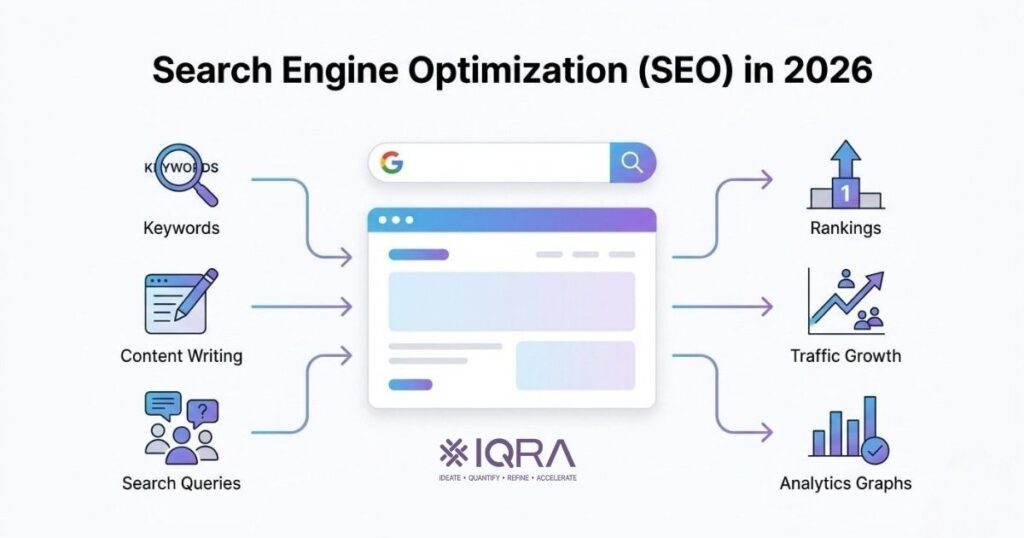
Table of Contents
What is Search Engine Optimisation?
Search engine optimization is the reason some websites show up on the first page of Google while others remain invisible no matter how good their content is. SEO is basically the process of making a website better so that search engines can understand it, trust it, and rank it higher than other pages for relevant searches.
In 2026, understanding what is search engine optimisation means has become more complex. AI-powered search summaries, voice search, and Google’s evolving quality standards are all reshaping how results are shown — and who gets to appear in them.
The Core Idea Behind Search Engine Optimisation
Search engine optimisation is all about trust and relevancy at its core. The purpose of search engines is to find answers. Google’s job is simple — show the best answer to the user as fast as possible.
As the owner of a website, it’s your obligation to make it clear to Google that your page is that result.
That means that three big sectors need to work together. First, the content you write ought to be what your readers are looking for. Second, your site’s technical base needs to be clean, fast, and easy to crawl. Third, other trustworthy websites should link to your content or mention your business. This shows that your content is credible.
BrightEdge’s 2025 research shows that organic search brings in more than 53% of all trackable website traffic across all industries. This makes SEO the biggest source of website traffic today. That number has stayed the same even as social media and paid marketing have become more popular. This shows how important SEO still is.
How What is Search Engine Optimisation Works
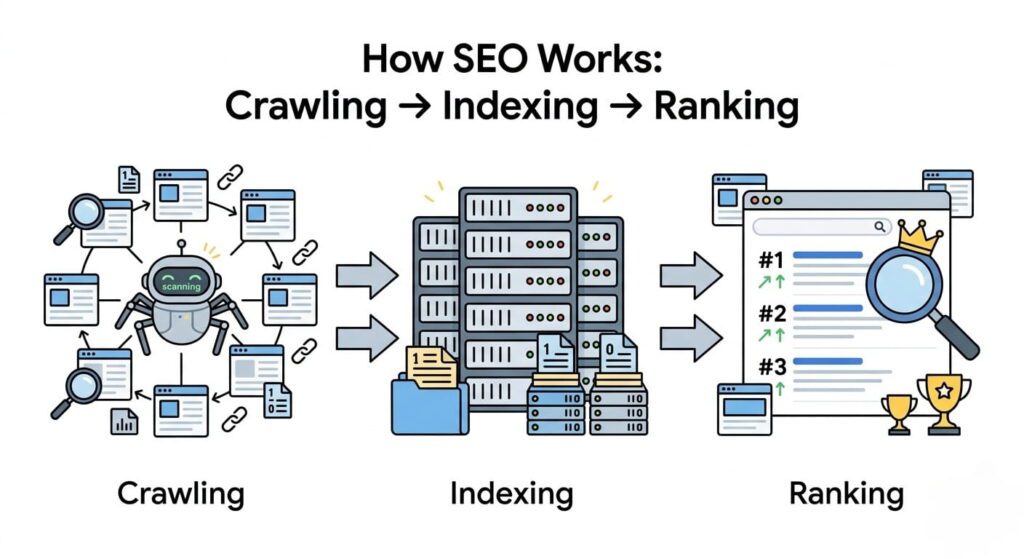
A lot of people think that SEO is mostly about utilising the perfect words. Keywords are important, but they are only one part of a bigger picture. From the point of view of a search engine, this is how the process really works.
Step 1 — Crawling
Search engines use bots called crawlers to wander across the web, following links to find new and updated pages. Crawlers could miss a lot of your content if your website has broken internal connections, pages that are blocked in your robots.txt file, or a sitemap that hasn’t been sent in.
Step 2 — Indexing
After a search engine crawls a page, it decides if it should keep it in its index. Pages that are thin, have duplicate content, or don’t have obvious topical signals sometimes don’t get indexed at all. Google’s helpful content technologies have made this step far more selective than it was just three years ago.
Step 3 — Ranking
SEO strategy is most clear when it comes to ranking. Google looks at more than 200 factors, such as site speed, content quality, backlink authority, user engagement metrics, and more and more, E-E-A-T (Experience, Expertise, Authoritativeness, and Trustworthiness), to decide which pages show up where.
The key to conducting SEO smartly instead of merely mechanically is to understand this flow.
How to Optimise Your Website for Search Engines in 2026
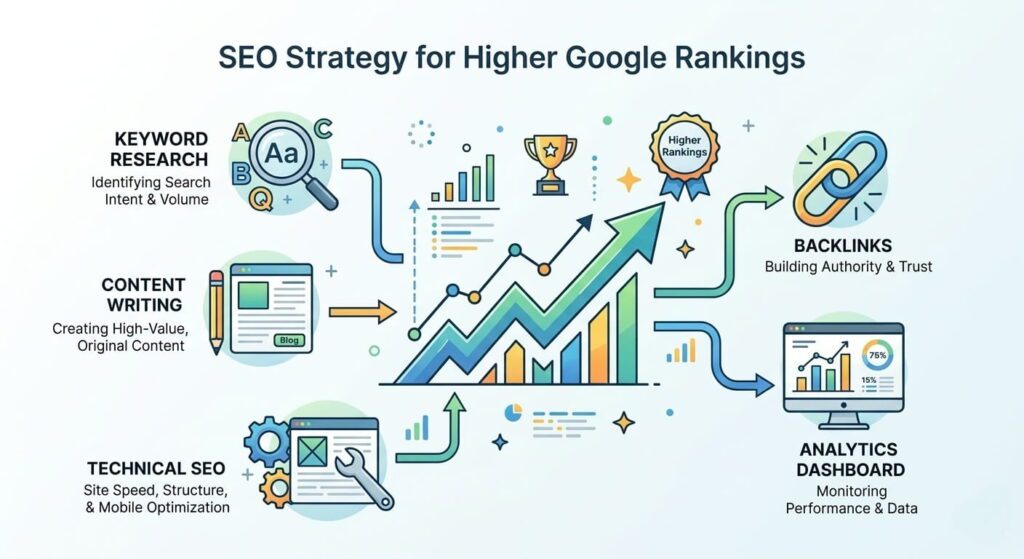
The logic behind the approach is the same whether you’re starting a new site or improving an old one. Here is a useful breakdown.
Keyword Research:
Keyword research is the process of finding out the exact words and phrases that your target audience types into search engines. Good keyword research takes into account search volume (how many people look for a term), keyword difficulty (how hard it is to rank for it), and search intent (what the person really wants when they enter it).
Google Search Console and Google Keyword Planner are two good free tools to start with. Paid tools like Ahrefs, Semrush, and Ubersuggest give you more detailed information about your competitors.
In 2026, keyword research based on intent is more important than keyword volume. A page that correctly addresses a specific, low-volume question will frequently do better than a general page that targets a wide, high-volume phrase.
On-Page SEO:
On-page SEO is anything you can change immediately on a page. This includes your URL structure, heading hierarchy, picture alt text, internal links, and, of course, the content itself. Every page should have a clear main keyword and a few related secondary keywords that are naturally included rather than forced.
Technical SEO:
Technical SEO is the part of your site’s backend that influences how crawlers work with it. This includes Core Web Vitals (Google’s performance standards for loading speed, interactivity, and visual stability), mobile responsiveness, HTTPS security, and a logical site structure. If you don’t pay attention to technical SEO, people may never find your outstanding content.
Content Strategy:
Google’s helpful content system, which grew a lot in 2024 and 2025, now checks to see if content was made for people first and not only to rank. those that are thin and templated don’t do as well as those that show actual expertise, answer real questions completely, and give something new.
Link Building:
Backlinks are still one of the best ways to tell how well a page ranks. When trustworthy websites connect to yours, it shows that they trust your material. It’s much more important to have high-quality and relevant connecting domains than to have a lot of them. One link from a reputable industry journal is worth more than hundreds of links from directories with low authority.
Website SEO Analysis
You need to know where you stand right now before you can make your SEO better. There are many parts to a good SEO study of a website.
Technical Crawl
Tools like Screaming Frog, Google Search Console, or Semrush Site Audit can help you find crawl mistakes, slow-loading pages, broken links, duplicate content concerns, and gaps in your site’s indexation.
Content Gap Analysis
Content gap analysis shows you the searches your competitors rank for that you don’t, so you know what subjects and pages you need to make or improve.
Backlink Profile Review
Review your backlink profile: Before making new links, you need to know which domains connect to you, how authoritative they are, and if any of the links are bad.
Core Web Vitals Check
Check your Core Web Vitals: Google’s PageSpeed Insights gives you real-world performance data and precise suggestions for how to make things better.
How to Rank Higher on Google in 2026: What Actually Works
It’s not about hacking an algorithm to get high rankings on Google in 2026. It’s about really being the best response for the people you want to reach. That being said, these are the exact things that always set high-ranking pages apart from the rest.
Topical Authority
Google sees you as an expert when you publish a lot of related, detailed information on a topic. A group of articles on a subject that are all linked together does better than a single page.
Search Intent Alignment
Make sure that the format, depth, and angle of your material match what customers expect when they search for something. Educational content is needed for informational questions. Transactional questions demand clear calls to action and explicit product information.
AI Overview Optimisation
Google’s AI Overviews show up at the top of many search pages in 2026. Pages that are included in these summaries are usually clear, well-organised, short in important parts, and full of facts. Putting clear answers first and then supporting information in your article greatly increases your chances of being found in this manner.
Page Experience
Users stay on your pages longer if they load quickly, don’t change the layout too much, are easy to navigate, and have a mobile experience that doesn’t make them angry. This affects how Google ranks your pages.
Content Freshness
Google’s freshness algorithm gives higher rankings to pages that are kept up to date. One of the best things you can do for SEO is to go back and update previous blogs with new information, examples, and internal links.
What is Search Engine Optimisation in AI Search Era
Many marketers are concerned about the rise of AI-generated search summaries — Google AI Overviews, Bing Copilot, and Perplexity. If AI answers the query directly, does ranking still matter?
Yes, a lot. AI search tools get their answers from web information that has been indexed. Your information is more likely to be acknowledged in such AI summaries if it is well-organised, clear, and authoritative. This means that search engine optimisation in 2026 will contain not only classic blue-link results but also results that are geared for AI-assisted search.
Structured data markup (schema.org), explicit FAQs in your content, direct answers in the first few paragraphs, and strong E-E-A-T signals all make it more likely that you will show up in both traditional search results and AI-generated responses.
What is Search Engine Optimisation Requires in 2026
In 2026, search engine optimisation is not a technique or a quick fix. It takes a lot of work and money to make your website truly useful, technically sound, and an authority in your field. Companies that see the best results are those that regard SEO as a long-term growth channel instead of a one-time job.
If you want people to find your brand, you need to know what search engine optimisation is at a deep level and then constantly put that knowledge into action. This is what sets companies that get found apart from those that stay hidden.
Ready to build a search presence that compounds over time? Explore IQRA Digital Solutions’ SEO services → or Get a free website assessment →
FAQs:
In basic terms, what is search engine optimisation?
Search engine optimisation is the process of improving a website’s content, structure, and authority so that search engines like Google rank it higher in results for relevant searches — helping people find your site without paid advertising.
How long does it take for SEO to work?
Most websites start to see changes in their rankings within 3 to 6 months of doing SEO work on a regular basis. In industries that are more competitive, it may take 6 to 12 months to see big gains. SEO builds on itself over time, so the results get better the longer you spend money on it.
What are the differences between On-page SEO and Off-page SEO?
On-page SEO is anything you can change directly on your website, like the content, title tags, headings, internal links, and how fast the site loads. Search engines use off-page SEO to figure out how authoritative you are. This includes backlinks from other websites, mentions of your brand, and social signals.
Should I hire an SEO agency or do it myself?
You can definitely do basic SEO on your own, especially if your website is fresh or small. But when your ambitions get bigger or the competition gets tougher, an expert SEO partner can be quite helpful. The most important thing is to learn the essentials so you can judge a strategy well no matter who carries it out.
How do I check the SEO performance of my website?
Use Google Search Console (which is free) to look for problems with indexing, manual operations, and keyword performance. Use a program like Screaming Frog or Semrush Site Audit to do a technical crawl of your site.
Then, check your content against the search intent for your target keywords and look over your backlink profile. These steps, when taken together, provide you a clear, actionable picture of where you are.
Written by IQRA Performance Team at IQRA Digital Solutions — their experience in SEO strategy, technical SEO, or digital marketing. “LinkedIn“