

How Shopify Website Design Works in 2026
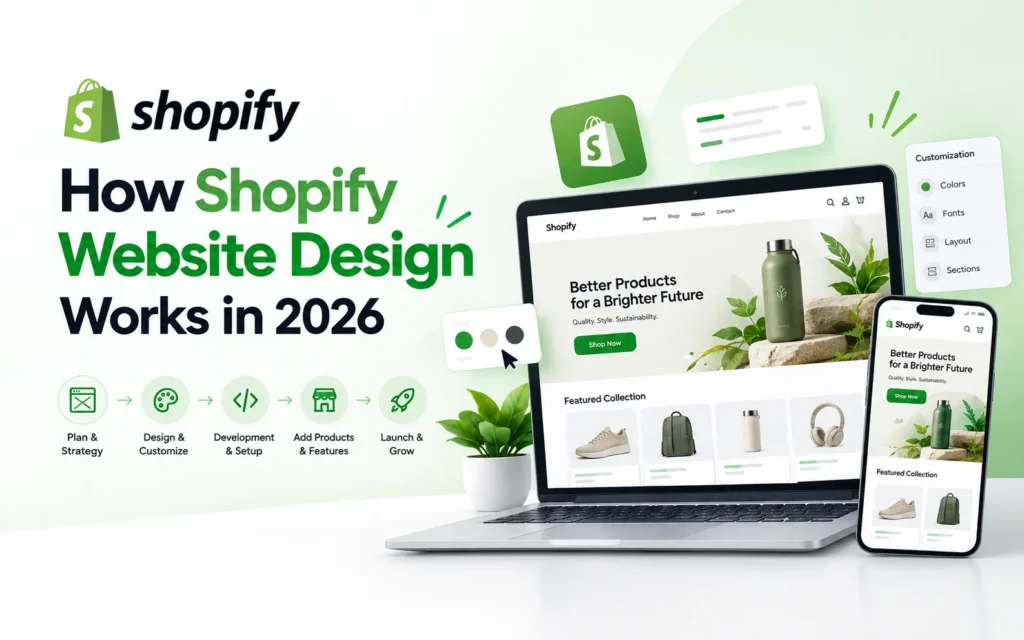
Table of Contents
Shopify website design refers to the process of creating an online store on Shopify that is visually appealing, easy to navigate, and optimized to convert visitors into customers.
In 2026, Shopify website design is not just about appearance — it directly impacts trust, user experience, and sales performance. A well-designed store guides users smoothly from browsing to checkout, while a poorly designed one leads to confusion and drop-offs.
3 Things to Define Before You Start Building Your Shopify Store
When someone visits your Shopify store, they don’t start by analysing your product — they react to your website. Within a few seconds, they decide whether your brand feels trustworthy, easy to understand, and worth exploring. This entire experience is shaped by your website design.
Shopify website design is not just about colors and layout. It defines how your products are presented, how smoothly users can navigate, and how quickly they understand what you’re offering. A well-designed website reduces confusion and builds confidence, while a poorly designed one creates friction and leads users to drop off before they even consider buying.
3 Things to Clarify Before You Design Your Shopify Store
Before you start building your Shopify website, there are a few fundamentals that need to be clear. Most businesses jump directly into selecting a theme or adding products, but without clarity, even a good-looking website fails to perform.
You need to understand who your customer is, what problem you are solving, and what action you want the user to take. Your website design should be built around this journey. From the first screen to the final checkout, every section should guide the user forward without confusion.
Without this clarity, design becomes random. And random design rarely converts.
Shopify Website Design vs. Development: Understanding the Difference
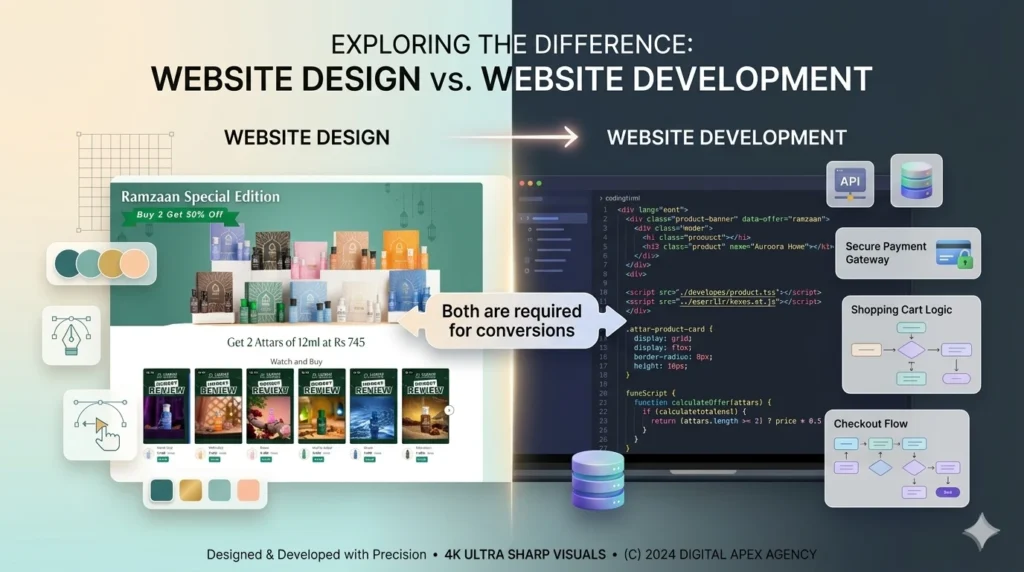
One of the most common misunderstandings among business owners is treating website design and website development as the same thing. In reality, they solve two very different problems.
Website design focuses on how your website looks and feels. It decides the structure of the page, placement of elements, visual hierarchy, and how users interact with your content. Website development, on the other hand, is about functionality. It ensures that buttons work, pages load correctly, and integrations like payment gateways run smoothly.
A simple way to understand this is to think of design as the showroom and development as the engine. The showroom attracts people and shapes their perception, but the engine ensures everything works as expected. However, if the showroom itself is not appealing or confusing, most users won’t even stay long enough to experience the functionality.
How Shopify Website Design Is Built: The Role of Figma and Design Tools
In professional workflows, website design does not start directly on Shopify. It starts with design tools like Figma where the entire structure of the website is planned before development begins.
Using Figma, designers create layouts for different pages such as the homepage, product pages, and landing pages. They define how sections will be arranged, how users will scroll, and how information will be presented. This helps in visualizing the complete user journey before anything is built.
Figma also allows teams to collaborate, review designs, and make changes quickly. This makes it easier to align design with business goals before moving to development.
Limitations of Figma in Modern Design Workflows
While Figma is powerful, it still relies heavily on manual effort. Every section, every variation, and every layout needs to be created by the designer from scratch. This makes the process time-consuming, especially when multiple design options need to be tested.
Another limitation is speed. When working with performance marketing campaigns, businesses often need multiple landing page variations quickly. Creating each variation manually slows down execution.
This is where traditional design workflows start becoming a bottleneck.
How AI Tools Like Stitch Are Changing Website Design
This is where newer tools like Stitch are changing the way designers work. Instead of building designs element by element, designers can now generate layouts using prompts and refine them further.
Stitch allows designers to quickly create multiple design variations, test different layouts, and iterate faster. What earlier took hours can now be done in minutes.
This does not replace designers, but it changes their role. Instead of spending time on repetitive tasks, they can focus on refining the design and improving user experience.
How Stitch Helps Teams Design and Launch Shopify Sites Faster
The advantage of tools like Stitch comes from how quickly they help in generating and exploring ideas. Designers can create multiple layouts, experiment with different structures, and visualize concepts without starting from scratch every time.
This makes it easier to test what works best for users, especially when designing landing pages for campaigns. Faster ideation leads to faster execution, which directly impacts how quickly businesses can launch and optimize their websites.
Why Shopify Design Mockups Make Development Faster and More Accurate
Once the design is ready, whether created in Figma or generated using tools like Stitch, it acts as a blueprint for developers. A clear mockup removes guesswork and ensures that developers understand exactly what needs to be built.
Without a proper design mockup, developers often have to make assumptions, which leads to inconsistencies and multiple revisions. This increases both time and cost.
A well-structured design makes development faster, smoother, and more accurate. It ensures that the final website matches the intended user experience.
Why Theme-Based Shopify Websites Can Slow You Down
Shopify themes are often seen as a quick and cost-effective way to build a website. While they do help in launching faster, they come with certain limitations that most businesses overlook.
Themes are built to cater to a wide range of use cases. Because of this, they include many features and scripts that your business may never use. These unnecessary elements increase page load time and affect website performance.
Research shows a one-second delay in page load time reduces conversions by 7%, and 53% of mobile users abandon sites that take longer than three seconds to load. Google PageSpeed Insights research Bloated themes directly cost you sales.
How to Build Shopify Website Design the Right Way
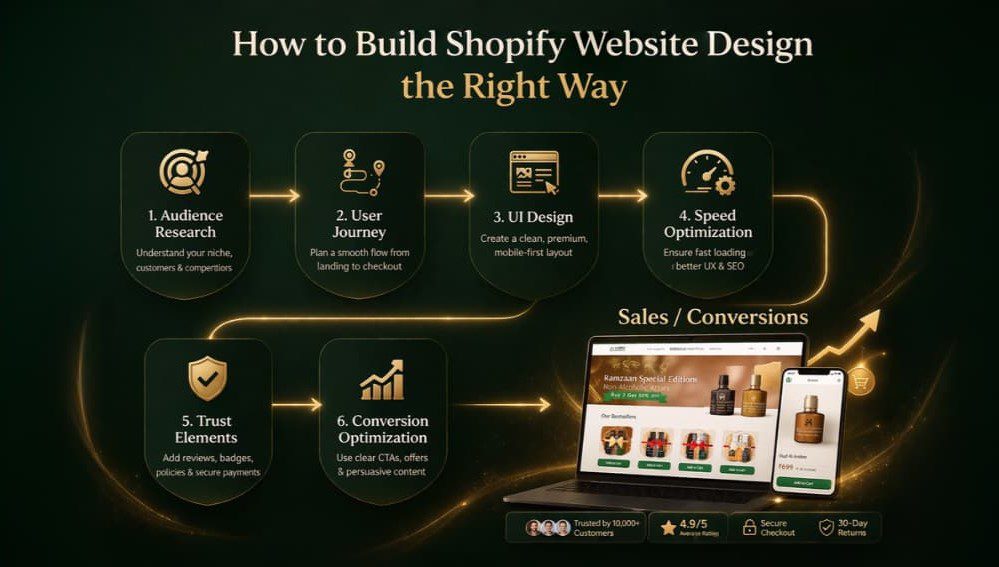
A high-converting Shopify website follows a structured approach:
Step 1: Understand your audience
Step 2: Plan user journey
Step 3: Design clear layouts
Step 4: Optimize speed & mobile experience
Step 5: Add trust elements (reviews, guarantees)
Step 6: Continuously improve based on data
Conclusion
Shopify website design in 2026 is no longer just about building an online store — it is about creating a structured, high-converting experience that turns visitors into customers.
Businesses that focus on user experience, speed, and clear messaging consistently outperform competitors who rely on basic templates.
If your Shopify store is getting traffic but not generating sales, improving your website design can be the biggest growth opportunity.
Looking to Build a Shopify Website That Converts?
At IQRA Digital Solutions, we build Shopify websites designed for conversions — every element planned to guide visitors toward action. If your store is getting traffic but not generating sales, get a free Shopify website review → or explore our Shopify design and digital marketing services →.
FAQ
What is Shopify website design?
Shopify website design is the process of planning, structuring, and visually building a Shopify store so it attracts customers, communicates your brand clearly, and guides visitors toward purchasing.
How is Shopify website design different from development?
Design covers how the store looks, feels, and guides users. Development covers how it functions — payments, integrations, speed, and backend systems. Both are essential for a high-converting store.
Why do Shopify themes slow down your store?
Themes are built for a wide range of use cases and contain scripts and features your store may never use — adding unnecessary page weight, slowing load times, and reducing conversions.
How long does Shopify website design take?
A standard Shopify design project typically takes 3–5 weeks. Custom builds with advanced features may take 6–10 weeks depending on complexity and integrations required.
Written by IQRA Team at IQRA Digital Solutions, specializing in Shopify design and performance-driven digital marketing. LinkedIn Profile