

D2C Website Development Roadmap: Complete Step-by-Step Guide (2026)
Table of Contents
The decision to build a D2C brand website development roadmap, following years of corporate or business experience, is not an experiment. You already understand your customers, margins, operations, and growth. A clear website development roadmap is where your business vision is transformed into a scalable digital asset.
A website is not just a design project. For a D2C brand, it is a sales platform, brand touchpoint, and data engine. Without a structured plan, even well-funded projects can fail to deliver results. This guide explains a practical, step-by-step roadmap built for founders who think long-term.
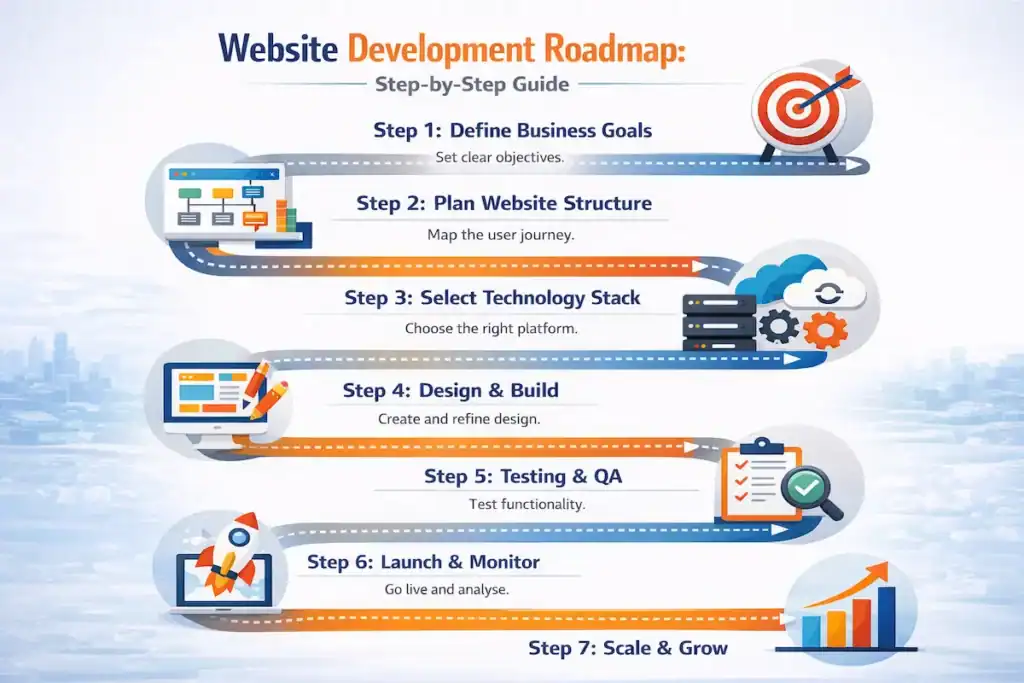
Step 1: Get Your Business Objectives Before Anything Else
Before you even think about layouts or picking out colours, you have to get clear on your business goals. There’s no point talking about tech or design until you’ve defined exactly what you need the website to do for you.
Ask yourself:
- Direct online sales, or lead generation or positioning?
- Who is the ideal customer?
- What must users do on the site?
Once such responses are evident, the site ceases to be a project and begins to be a system that is constructed based on quantifiable results.
Step 2: Change Goals into a Website Design Roadmap
After setting objectives, they should be converted into a definite roadmap of website design. The roadmap will help identify the way the users will navigate through the site, from their initial visit to the last action.
Key elements include:
- Site organisation and hierarchy of pages.
- User journey mapping
- Specifications of page content.
- Conversion points (Add to Cart, Checkout, Forms, CTAs)
A defined roadmap will see to it that the site is not built to be pretty but usable and convertible.
Step 3: Select the appropriate Technology Stack
Early decisions relating to technology are long-term. The platforms that have been selected due to speed or convenience may become restricted in the future.
Factors to consider when planning this stage include:
- Shopify, WooCommerce, custom CMS.
- Hosting and server scalability.
- Information security and privacy.
- Integration of marketing applications, analytics and CRM.
The common problem with many of the failed web development experiences is that the technology was not capable of supporting expansion. A proper roadmap is one that envisages the direction the business is going and not the direction it is currently going.
Step 4: Adopt a Systematic Web Design
Design must not only be aesthetically good but also problem-solving. Such a strict Web design regimen can be used in the process to see that visual decisions are made on the basis of usability and performance.
Best practices include:
- Mobile-first layouts
- Fast-loading pages
- Clear navigation
- Powerful product presentation.
- Simple checkout flow
On high-performing D2C websites, the choices in designs are made based on the user behaviour and data, not individual preferences.
Step 5: Quality Control and Development, Testing
Implementation must not be in a hurry. A good roadmap will divide the development into manageable stages with checks in each stage.
Each phase should include:
- Feature-wise development
- Regular reviews and demos
- Performance testing and functional testing.
- Cross-binding and cross-platform testing.
One of the most costly errors that founders commit is skipping testing. Even some small problems can influence conversion and credibility directly.
Step 6: Launching is Never the End. It is the Starting Point.
After launching the site, the actual information begins to flow in. Real performance data, drop-offs, and user behaviour become the basis of choice.
Post-launch focus areas:
- Performance optimisation
- Coverage Conversion rates.
- Bug fixes and updates
- Improvement of features through user behaviour.
The founders of most companies view the beginning as the final. In reality, an appropriate roadmap to create a site views the launch as the starting point of further development.
Step 7: Scale and Long-term Growth Plan
Your location must be capable of supporting the growth as the traffic and orders increase. The development plan of the road map to make the website future-ready would entail:
- Cloud computing and scaling.
- Clean, maintainable code
- Elaborate installation of new tools.
- Data tracking of informed decision.
The common feature of most successful web development cases is that scalability was not added in a hurry.
Final Thoughts
In the case of seasoned founders, to create a website without planning is like operating a company without planning. A strong website development roadmap takes the business objectives, user experience, technology and expansion into a single decisive direction.
When analysing web development examples or developing your own plan, do not look at the quick-fix solutions, but at long-term value. A systematic process minimises risk, enhances performance and helps growth sustainability.
Your site is not a cost.
It is a business mechanism–and your road map will make it strong or weak.
Frequently Asked Questions
What is a website development roadmap, and why do I need it?
Imagine it as your roadmap. It is a map outlining all the tasks you need to take, starting with the first idea, to the construction, the launch, and the way you will expand in the future. In the case of D2C brands, this is enormous since it maintains the focus on the real things that matter, revenue and growth and does not simply cull out pretty colours.
Is it possible to reverse the plan after we have started?
A good roadmap is not predetermined; it is made to be changeable. You must be able to make adjustments based on what you learn in the process of testing or changing the objectives of the business, and not have the entire project go down the drain.
What is the time span required to complete a website development roadmap?
On average, however, the time required to have the first site up and running is around 4-5 weeks, depending on the level of complexity. It is just important to remember that it is not literally the end of the roadmap as soon as the site is launched, optimisation and improvement of the site is a process.
Do we have any existing founders who need a created procedure of website procedure?
An established web design process will ensure there is a reduction in risks and long-term returns, although business experience-strategy, technology, and implementation will be harmonised.
Let us know your thoughts in the comments & you can also reach out to us via submitting the form – IQRA Digital Solutions