

How Facebook Meta Ads Auction Works in 2026

Table of Contents
When and Why Does an Auction Take Place?
In Facebook Meta Ads, an auction happens every time there is an opportunity to show an ad to a user. With millions of users active across Meta platforms at any moment, advertisers compete in real-time whenever a user opens Facebook, Instagram, or Messenger. The purpose of the auction is simple — to determine which ad delivers the highest overall value for that specific user at that specific time.
Meta does not randomly show ads. It uses its auction system to decide which advertiser wins the impression.
Who Competes in the Facebook Meta Ads Auction?
Every user on Meta has multiple behavioral signals and interests.

A single person may be interested in:
- Sports
- Politics
- AI & Technology
- Perfumes
- Travel
Some interests may be unrelated, while others may overlap, such as:
- Education
- IIT preparation
- Memory exercises
- Meditation
These are not just declared interests — they are behavioral signals based on engagement, browsing patterns, watch history, and interactions.
Let’s understand this with an example.
Imagine a person named Suresh who wants to become a professional footballer and play for the Indian National Football Team.
Suresh may show signals related to:
- Football shoes
- Stamina training
- Gaming
- Bicycle
- Meditation
Now, multiple advertisers using Facebook Meta Ads may target users like Suresh.
Advertiser 1
Targets interests such as Football Shoes, Gym, Sports, Fitness.
Advertiser 2
Targets Gaming Computer, Retro Gaming, Video Games, PlayStation.
Advertiser 3
Targets Meditation, Students, Psychology, Self-Improvement.
Even though these advertisers sell completely different products, they may still compete in the same auction if Suresh qualifies for their targeting conditions at that moment.
This is how Facebook Meta Ads creates indirect competition between advertisers who are not traditional market competitors.
And Suresh is not the only one. Millions of similar users trigger these auctions daily.
Audience Fragmentation and Overlap in Meta Ads
When an advertiser selects multiple interests inside separate ad sets, they divide their potential audience into smaller segments. This is known as audience fragmentation.
However, some users may fall under multiple interest groups.
For example, someone interested in both:
- Football Shoes
- Gym
If an advertiser runs:
- Campaign 1 targeting Football Shoes
- Campaign 2 targeting Gym
The same user may qualify for both campaigns.
This creates audience overlap.
If both campaigns enter the same auction for that user, it can result in internal competition inside the same ad account. This is commonly referred to as auction overlap.
How Is the Winner Decided in Meta Ads?
The winner of the Facebook Meta Ads auction is determined by total ad value.
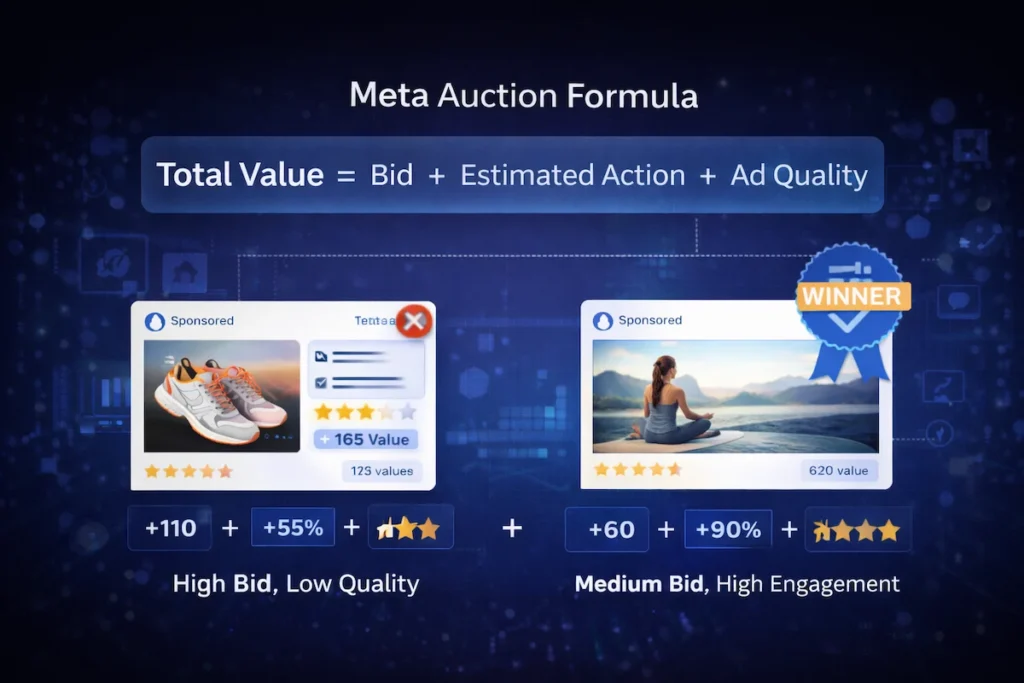
Meta evaluates three core components:
Bid
Your bid strategy (lowest cost, cost cap, bid cap, etc.) determines how much you are willing to pay for a result.
Estimated Action Rate
This predicts how likely a user is to engage with your ad — such as clicking, watching, commenting, or converting — based on historical data and user behavior signals.
Ad Quality
Ad quality includes:
- Creative relevance
- Engagement authenticity
- Avoidance of engagement bait
- Landing page experience
- Offer clarity
Meta combines these elements into a total value calculation.
The ad with the highest overall value wins the auction — not necessarily the highest bidder.
This is why creative quality often beats higher budgets.
How Can Your Meta Ads Win Auctions and Still Be Profitable?
Winning the auction is only half the battle.
To consistently win auctions at a lower cost per result:
- Your creative must grab attention naturally (not clickbait)
- Your messaging must be clear and aligned with user intent
- Your targeting must be structured properly
- Your landing page must match the ad promise
If you are running a D2C store and driving traffic to a product page, but users are not adding to cart or completing purchases, the issue may not be the ad — it could be the store experience.
In Facebook Meta Ads, post-click experience directly affects overall campaign profitability.
How to Develop Better Creatives for Meta Ads?
To improve creative performance:
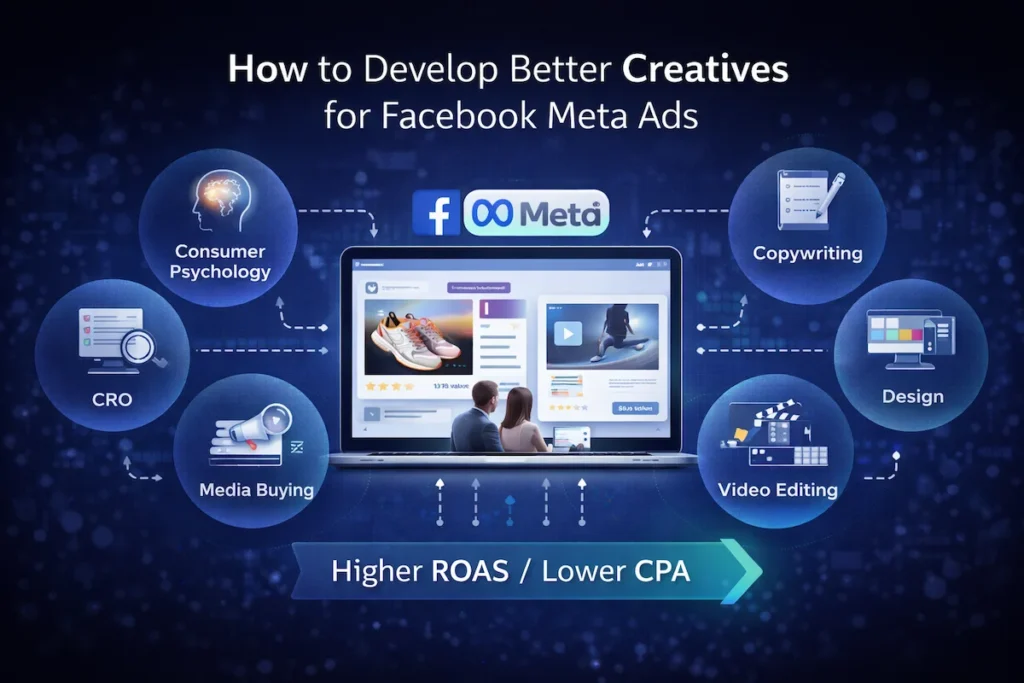
You need:
- Someone who understands consumer psychology
- A strategist who can craft persuasive ad copy
- A strong designer for static creatives
- A skilled videographer and editor for video ads
Creative production is not random design work — it’s strategic communication aligned with buyer intent.
If managing all these resources in-house is difficult, outsourcing to a performance-focused team can help.
interest targeting meta ads
At IQRA Digital Solutions, we specialize in managing Facebook Meta Ads campaigns end-to-end — from strategy and creative production to media buying, ad account optimization, and conversion rate optimization.
You can connect with our team for a FREE consultation session where we audit your D2C store and ad account and share actionable insights to improve performance.
Frequently Asked Questions (FAQs)
How does Facebook Meta Ads auction work?
Facebook Meta Ads uses a real-time auction system where advertisers compete for impressions. The winner is determined based on bid amount, estimated action rate, and ad quality to deliver the highest overall value to the user.
What is estimated action rate in Meta Ads?
Estimated action rate predicts the likelihood that a user will engage with your ad based on historical behavior, platform signals, and campaign data.
Does a higher bid guarantee winning the auction?
No. In Facebook Meta Ads, ad quality and estimated engagement play a major role. A well-optimized ad with strong engagement can outperform a higher bid.
What is audience overlap in Meta Ads?
Audience overlap happens when multiple ad sets target similar users, causing internal competition within the same ad account.