
What is Meta Ads? The Complete Guide for Beginners
If you are exploring paid advertising for your business, one of the first questions you are likely to ask is: what is Meta Ads and why does everyone in marketing keep talking about it.
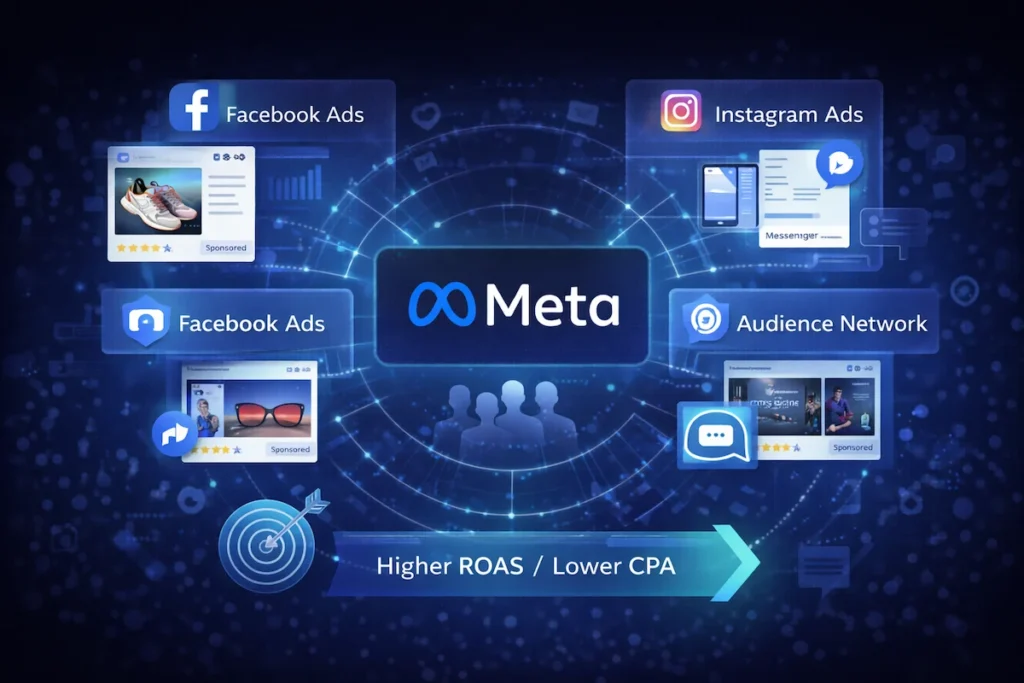
Meta Ads refers to the advertising platform operated by Meta Platforms, the parent company of Facebook and Instagram. It allows businesses to promote products, services, content, and offers across the Meta ecosystem including Facebook, Instagram, Messenger, and the Audience Network. What makes it powerful is not just reach, but the depth of targeting and data-driven optimization built into the platform.
Recent statistics suggest that Meta’s main programs, like Facebook, Instagram, WhatsApp, and Messenger, have more than 3 billion daily active users around the world. This scale shows how big the advertising possibility is in the Meta ecosystem.
But reach isn’t the only benefit. The real power comes from how well brands can reach people based on their interests, behaviours, and patterns of engagement. In this tutorial, we’ll explain what is Meta Ads, how they function, the different types of campaigns you can run, and how to use Meta Ads as part of a successful social media marketing plan.
What is Meta Ads and how Does Meta Ad work?
To really get Meta Advertising, you need to know how the system works behind the scenes.
Meta Ads are managed through Meta Ads Manager, the platform where advertisers create campaigns, set budgets, define audiences, upload creatives, and track performance. This is where advertisers establish campaigns, set goals, set budgets, pick audiences, upload creative materials, and keep an eye on how well they are doing.
At first, it might seem like too much, but after you get the hang of it, it makes sense.
The Structure of the Campaign
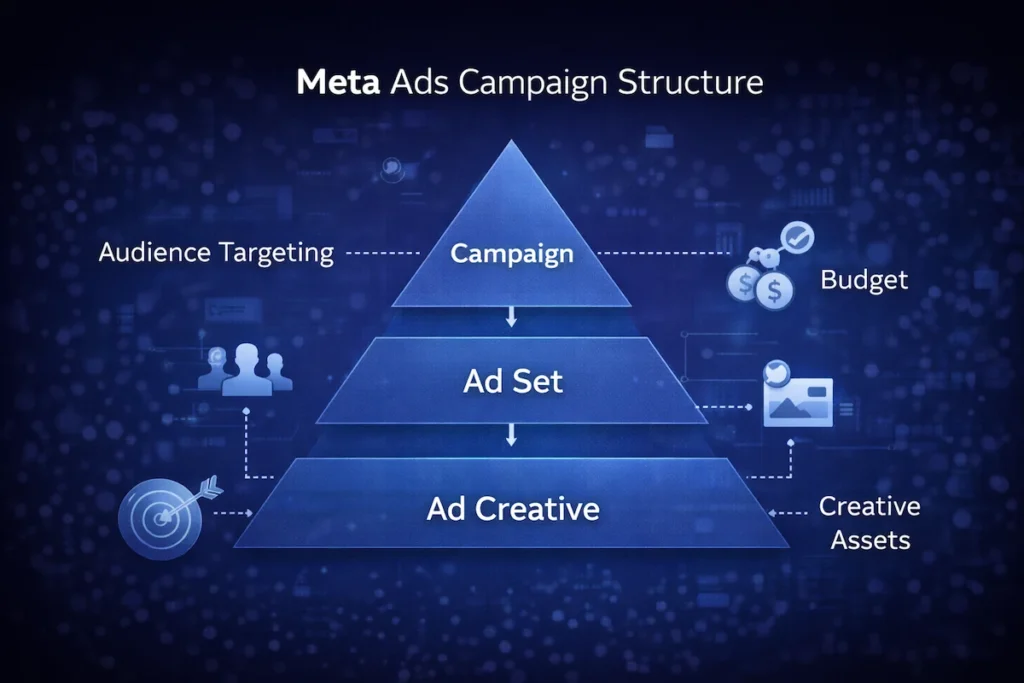
There are three levels to Meta Ads:
- Campaign
- Ad set
- Ad
You pick your goal at the campaign level. This informs Meta what you want to happen. Do you want to get more visitors to your website, more sales, more leads, more app installs, or more brand awareness?
You set your audience, budget, timetable, placements, and optimisation choices at the ad set level. This is where you make most of your big decisions.
You upload your creative at the ad level. The image or video, the headline, the main text, the call-to-action button, and the link to the destination are all part of this.
The easiest way to explain Meta advertise is that it is a performance-based advertising system More natural. That combines machine learning and user data to show adverts to those who are most likely to do what you want them to do.
Meta’s algorithm learns from how people use the site all the time. It looks at who clicks, who watches, who buys, and who doesn’t. Over time, it becomes better at showing your adverts to people who are like your best clients.
Meta’s internal reports show that advertisers who employ conversion-focused goals and pixel tracking do far better than those who merely focus on traffic. The technology optimises for results, not just clicks.
Different of Meta Ads Campaigns
Now that you know what is Meta Ads, let’s look at the different kinds of campaigns you may conduct.
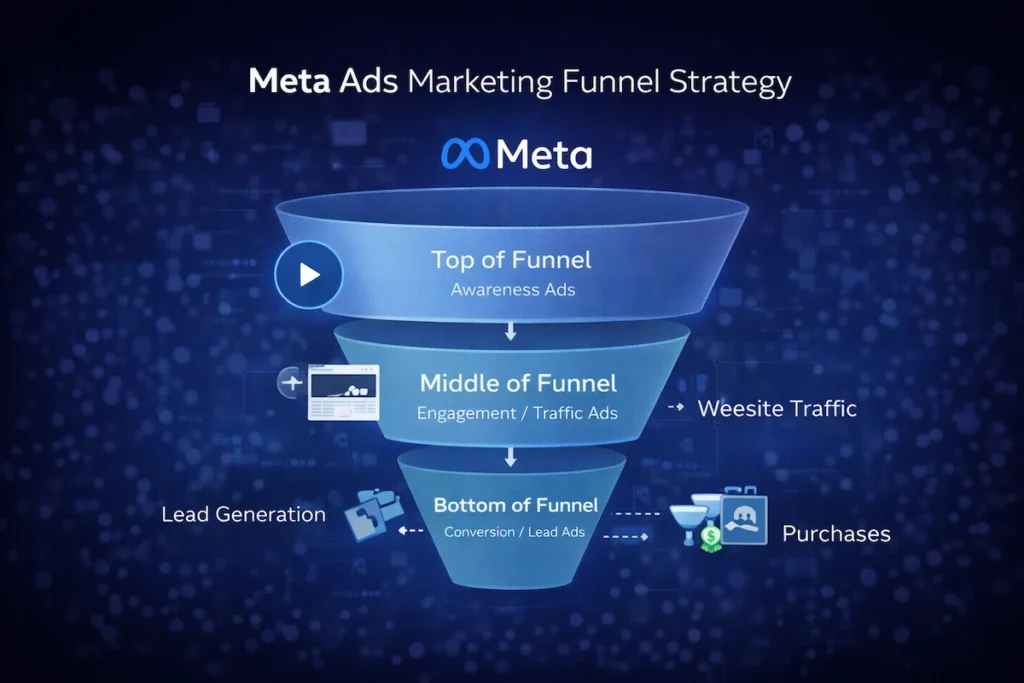
The goals of meta advertising campaigns shape how they are set up. These goals can be grouped into three main groups that match the marketing funnel: awareness, consideration, and conversion.
- Campaigns to Raise Awareness
These campaigns are meant to get your brand in front of new people. They care more about reach and impressions than making sales right away.
Some examples are:
- Campaigns to raise brand recognition
- Campaigns for reach
Use these when you want to be seen and known, especially when you are introducing a new product or entering a new market.
- Campaigns for Traffic
Traffic campaigns are meant to get people to go to a certain place, like your website, landing page, blog post, or app.
These campaigns are good for:
- Getting more people to visit your website
- Getting people to see material
- Getting users to go to sign-up pages
But just getting traffic doesn’t mean you’ll get conversions. That’s why experienced marketers generally use both traffic and remarketing methods.
3. Campaigns for Conversion
Meta advertising really shines in conversion campaigns. These campaigns work best when they lead to activities like buying something, submitting a lead, adding something to your basket, or installing an app.
You need to put the Meta Pixel on your website in order to execute conversion campaigns well. The pixel watches how users act and sends that information back to the algorithm.
Industry benchmarks indicate that the average conversion rate for Facebook ads across many industries is around 9 percent, which is often higher than several other social media advertising platforms. This makes Meta advertisements quite appealing for firms that sell things online or want to get leads.
The most important thing is to choose the proper aim that fits with your business goal. One of the most common mistakes beginners make is picking the wrong goal.
How to Use Meta Ads? Step by Step
If you’re new to running Meta Advertisement and want to know how to accomplish it, here’s a step-by-step guide.
Step 1: Set Your Goal
Before you use Ads Manager, be sure you know what success looks like. Do you want sales, leads, event signups, or downloads of your content?
Everything else depends on how clear this is.
Step 2: Set Up Your Pixel
Install the Meta Pixel on your website. You can’t track meaningful conversions without it. You can make retargeting and lookalike audiences with pixel data.
Step 3: Targeting Your Audience
One of the best things about Meta Advertisement is that they can target people quite accurately.
You can target based on:
- Demographics
- Behaviours
- Interests
- Custom audiences (those who visit your website or are on your email list)
- Lookalike audience
Lookalike audiences let you find people who are similar to your current consumers. Meta case studies show that advertisers who use lookalike audiences frequently obtain a better return on their ad spend than those who use broad targeting.
If you want to learn how to operate Meta Ads well, you need to know how people think. Targeting isn’t just a technical thing; it’s a strategic thing, too.
Step 4: Making a budget
You can set a daily budget or a lifetime budget. Beginners usually start small and then grow once their performance is stable.
Meta lets you optimise your campaign budget by dynamically spreading it out across ad sets based on how well they do.
Step 5: Testing Your Ideas
Everything is creative.
No amount of targeting can make weak messaging work. Try with different headlines, photos, videos, and formats. Short-form videos are quite compelling, especially when used on Instagram.
Meta’s own research shows that video advertising that works well on mobile devices gets more people to interact with them than static ads in many industries.
When you learn how to run Meta Ads, keep this in mind: always test and improve based on data, not guesses.
Meta Ads vs Google Ads: Key Differences
Comparing Meta Ads to other digital advertising platforms, especially Google Ads, might help you understand it better.
Meta Ads
Meta Ads is all about targeting based on interests and behaviour. People aren’t actively looking for items; they’re just skimming around social media. This means that your adverts get in the way of their experience.
Because of this, it’s important to have a strong emotional and artistic appeal.
Ads on Google
Google Ads focuses on targeting based on what people want. People are actively looking for something. It’s evident what someone wants when they type “buy running shoes online.”
Meta ads is better at generating demand. Google is better at capturing demand that is already there.
A lot of skilled marketers don’t pick one over the other. They combine the two. Meta raises awareness and keeps people interested. Google gets searches with a lot of intent.
Meta is different from other digital marketing ads since it focuses on storytelling, developing brands, and advanced audience segmentation.
How to Use Meta Ads in Your Social Media Marketing Plan?
Running ads on their own doesn’t usually lead to long-term success. Meta Ads must fit well with your whole social media marketing plan in order to have the most effect.
Aligning the Funnel
Think in terms of funnel stages.
- Top of the funnel: initiatives that make people aware of something who don’t know about it yet.
- Middle of the funnel: marketing to get people to engage with or visit your content.
- Bottom of the funnel: efforts that try to encourage people who visit a website or leave their shopping carts to convert.
This layered approach improves efficiency and reduces wasted spend.
Retargeting
Retargeting is where Meta ads become incredibly powerful.
You can retarget:
- Website visitors
- Video viewers
- Instagram profile visitors
- Past purchasers
Retargeting audiences typically convert at higher rates because they already know your brand.
According to industry benchmarks published by AdRoll, retargeting ads can increase conversion rates significantly compared to cold traffic campaigns. That is because familiarity builds trust.
When Meta Ads is integrated thoughtfully into your social media marketing strategy, it becomes more than a paid channel. It becomes a growth engine.
The Future of Meta Ads
Privacy changes such as iOS tracking updates have forced advertisers to adapt. First-party data collection is becoming more important than ever. Businesses must focus on building email lists, CRM systems, and strong customer relationships.
AI-driven optimization is also advancing rapidly. Meta continues investing heavily in automation tools like Advantage+ campaigns, which reduce manual targeting and rely more on machine learning.
Short-form video, creator partnerships, and conversational commerce are shaping the next phase of Meta advertising.
The fundamentals remain the same though. Clear objectives. Strong creatives. Smart targeting. Continuous testing.
Modern Meta advertising also integrates with CRM systems, first-party data strategies, and advanced machine-learning optimization.
Conclusion
However, the real difference comes from how strategically you implement and optimize it over time. Meta Ads is a paid advertising platform that allows businesses to promote their products and services across Facebook, Instagram, Messenger, and the wider Meta ecosystem. It helps brands reach specific audiences and drive measurable actions like website visits, leads, and sales.
But understanding Meta Ads is only the beginning. The real impact comes from how strategically you implement it. When campaigns are aligned with clear objectives, structured correctly, and optimized consistently, Meta advertising becomes a predictable growth channel instead of a trial-and-error expense.
Many businesses struggle not because the platform does not work, but because their strategy lacks clarity and proper tracking.
This article is written by the performance growth team at IQRA Digital Solutions, specializing in structured B2B Lead generation and performance marketing systems for growing businesses across Mumbai, India.
At IQRA Digital Solutions, we help companies implement structured digital marketing strategies focused on measurable ROI, long-term visibility, and consistent lead generation. Connect with our team to explore how Meta advertising can support scalable and sustainable digital growth for your business.
FAQ:
What is Meta Ads in simple terms?
Meta Ads is an online advertising platform that allows businesses to run paid promotions across Facebook, Instagram, Messenger, and the Audience Network. It helps brands reach targeted audiences and drive actions such as website visits, leads, or sales.
How is Meta advertising different from Google Ads?
Meta advertising focuses on interest-based targeting, meaning ads are shown based on user behavior and preferences while they browse social media. Google Ads focuses on search intent, meaning ads appear when users actively search for something. Both are powerful digital marketing ads platforms, but they serve different purposes within a marketing funnel.
How much budget do I need to start Meta Ads?
Initial performance data can appear within a few days, but stable and optimized results usually take a few weeks. Meta’s algorithm needs time to learn from user interactions before delivering consistent outcomes.
How long does it take to see results from Meta Ads?
Initial performance data can appear within a few days, but stable and optimized results usually take a few weeks. Meta’s algorithm needs time to learn from user interactions before delivering consistent outcomes.
Do I need technical knowledge to learn how to run Meta Ads?
While the platform has many features, beginners can start with basic campaigns and gradually learn advanced optimization techniques. However, for businesses focused on serious growth and ROI, working with experienced professionals ensures better strategy, tracking accuracy, and faster scaling.