

Shopify Ecommerce Website Development for D2C Brands: A Practical Guide
Strategic Shopify ecommerce website development is not about launching another online store. For D2C brands, it is about building a scalable digital asset that converts traffic into predictable revenue.
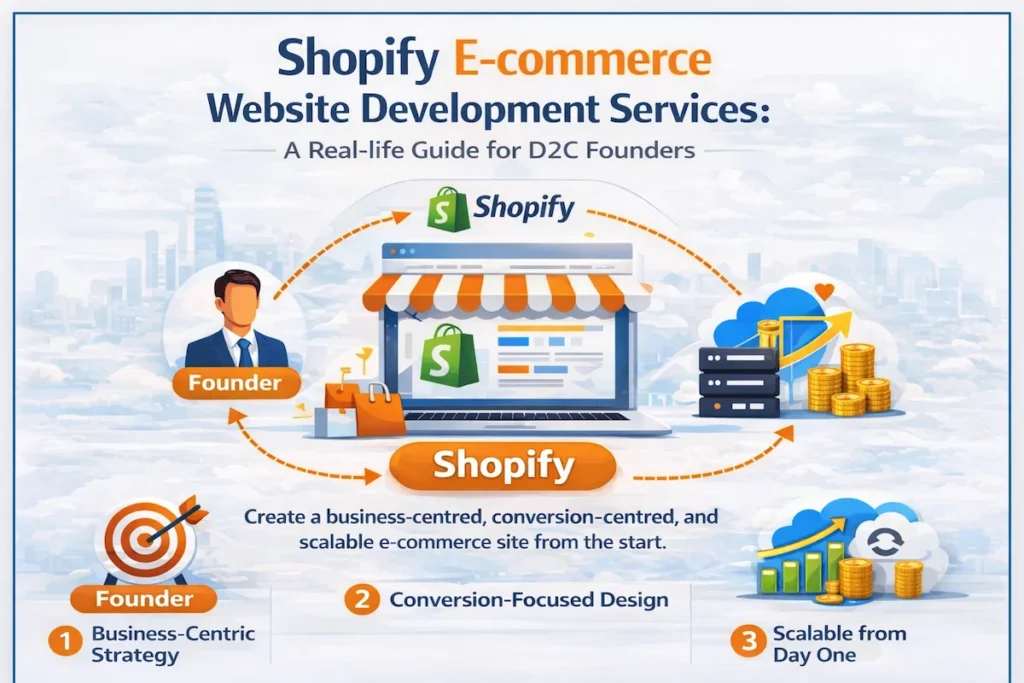
Developing a D2C brand based on years of corporate or business experience is not an experiment. You already know about customers, margins, supply chains and growth pressure. What you now require is a web-based trade system that will turn intention into income-on a predictable and substantial basis.
The e-commerce platform constructed by Shopify becomes applicable here. When they are well done, they make the operations easier and promote long-term growth. When poorly executed, they impose constraint and retardation on momentum.
The best way to build an ecommerce website that D2C founders should do is not to rush to build a store but to create a business-centred, conversion-centred, and scalable site with a business-to-customer strategy on the first attempt.
Why Shopify is the Perfect Digital D2C Business Model
Shopify powers millions of online stores globally and supports brands from early-stage startups to enterprise-level D2C companies.
Shopify has not become popular due to its being easy. It is favoured as it minimises the operational friction of those founders who prefer to work on brand, marketing and customer experience as opposed to infrastructure.
To a developing D2C company, Shopify provides:
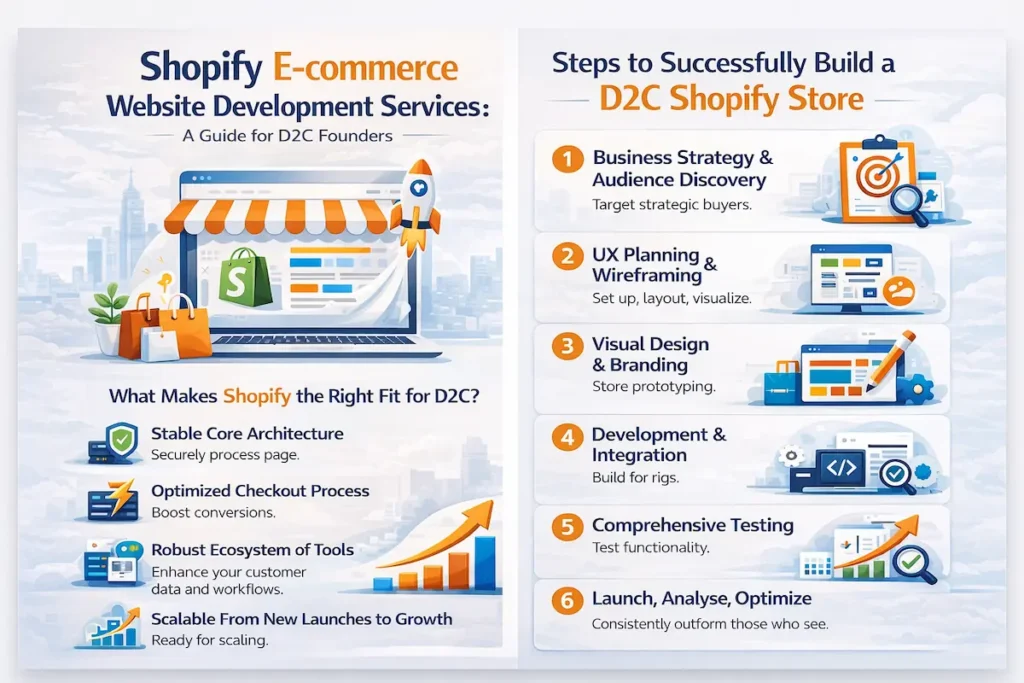
- Reliable and stable core architecture.
- In-house checkout optimisation.
- An established payment, logistics and marketing technology ecosystem.
- Scaling flexibility between early traction and large volumes.
Nevertheless, it is not the platform that makes it successful but its implementation.
Aligning Business Goals with Ecommerce Website Architecture
It is important to always begin with clarity before talking about themes, plugins or apps. The important questions that every founder has to respond to:
- Is the site aimed at sales in the short run, brand dominance or lead nurturing?
- Are the purchases one-time or repeat?
- To what extent are customer data and workflows to be controlled?
An effective e-commerce web design is developed on these responses. The navigation, product structure and checkout flow must back the business results- not just the aesthetics.
The Role of a Skilled Shopify Specialist
One of the most widespread errors is to believe that Shopify provides performance by default. It doesn’t.
A skilled Shopify developer knows how to:
- Speed up pages without affecting design.
- Organise collections and filters among high-intent users.
- Tailor the checkout and cart behaviour responsibly.
- Combine CRM, analytics and marketing automation in a clean manner.
In the case of founders, it will result in less compromising and less rebuilding of the business enterprise as it grows.
Designing for Conversion, Not Just Appearance
The beauty of the eye is great–but the transformation of it is better.
Best performing stores are constructed on:
- Good product hierarchy and message.
- SEO: Mobile frictionless
- Powerful product narration and social proof.
- Less effort is required in product discovery to check out.
This is where the professional e-commerce website development services are different from template-based ones. The user behaviour drives the decision, not the trends.
Shopify Ecommerce Website Development Process
In a case where founders are considering partners, it is useful to know how to build an e-commerce site properly.
A formalised methodology usually has:
- Discovery of business and audience.
- UX planning and wireframing
- Brand identity in line with visual design.
- Integration and development.
- Inter-device testing Inter-use-case testing
- Performance monitoring: Start with performance monitoring.
The process provides the development of e-commerce-based assets of websites that are stable, scalable, and measurable.
Post-Launch: Where the Real Growth occurs
The site is not the final point when it comes to launching the site. The activities of post-launch optimisation are aimed at:
- User behaviour and drop-off analysis.
- Increasing conversion rates bit by bit.
- Improving product presentation and offers.
- Within-system performance maintenance with traffic.
Continuous Shopify store optimization is what separates average D2C brands from category leaders.
Selecting an Appropriate Development Partner
When evaluating Shopify ecommerce website development partners, look beyond design portfolios and assess technical depth, performance benchmarks, and long-term scalability strategy.
Look for a team that:
- Appreciates business measurements, not only code.
- Does not just have portfolios, has real D2C experience.
- Discusses scalability and maintenance at an early stage.
- Not only delivery but long-term cooperation.
- A good growth partner is incorporated into your growth infrastructure.
Final Thoughts
Shopify is a potent base–but it needs to be combined with strategic implementation. In the case of founders who have real-world experience, it is not about going online. It is to create a digital asset that will compound over time.
Website development for e-commerce is a growth lever- not a constraint approached properly.
Frequently Asked Questions
Is Shopify good for D2C ecommerce website development?
Yes. Shopify is particularly effective when a founder already has experience in doing business, as it eliminates the technical aspect whereas enabling attention to branding, marketing, and customer experience. When properly implemented, it facilitates early traction as well as large-scale operations.
What is the difference between professional website development, e-commerce & a ready-made Shopify theme?
Themes are fast, whereas professional development is concerned with business logic- conversion optimisation, performance, scalability and integrations. Custom development also makes the sure that the site will expand as your business expands rather than be a hindrance in the future.
Which issues should be on the minds of founders in their e-commerce site planning?
Design and technology should be secondary to founders putting business goals, customer experience, and conversion funnel before design. A site that is designed with clear objectives will always perform well compared to one that is designed based on the visual aspect.
At what point would a D2C founder outsource a Shopify developer?
It is reasonable to hire a Shopify specialist in cases where the business needs custom workflow, performance optimisation, or third-party integration. It eliminates costly failures and shortens the time to market with minimal rebuilds in the future.
What is the typical time needed to build a Shopify-based D2C site?
A properly organised Shopify project can be accomplished in 4-8 weeks, depending on complexity, integrations and content preparation. Rapid development commonly causes technical debt and post-launch conversion problems.
Should Shopify stores be optimised after launch?
Absolutely. After launch, the true insights are generated, and non-experimental user behaviour, drop-offs, and performance data are used to make improvements. It is the continuous optimisation that separates the average stores and the high-performance D2C brands.
Book a free diagnostic call and understand exactly why your Google Ads are underperforming — and what to fix first.
IQRA Digital Solutions