

Shopify SEO Made Simple: Proven Tips to Rank Your Store Higher on Google
Launching your Shopify store is just the first step into the real market. To attract more organic traffic and to appear consistently on the search engines, you need to implement strong Shopify SEO. By optimising the overall website, product images and descriptions, and content on your Shopify website, you can increase sales without incurring high costs for paid ads.
In this article, we shall see how Shopify SEO works, the important optimization checklist, and a few proven strategies to rank your Shopify store. Stay with us till the end to enhance your site’s performance.
What Is Shopify SEO?
Shopify SEO is the process of optimising your website to increase its visibility in various search engines. It includes keyword research, technical improvements, content optimization, internal link building, and optimization of product and collection pages to drive more organic traffic.
How Does Shopify SEO Work?
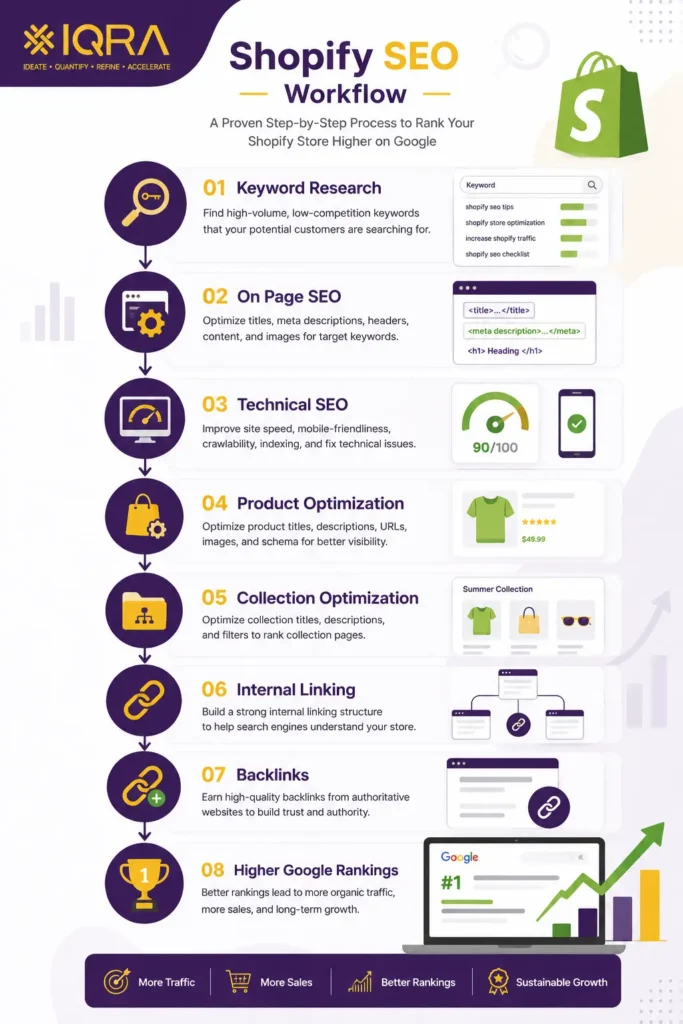
Search Engine Crawling and Indexing
Search engines discover your Shopify pages via crawling and add them to the index. Once the pages are indexed, they start appearing in the search results. To make this process smooth, you must have an updated sitemap. Proper site structure and accurate internal links.
Shopify Ranking Factors
There are hundreds of factors, some of which are known, and some are hidden. The few known factors are content relevance, usage of right keywords, page speed, backlinks, Website authority, domain authority, mobile friendliness, etc. A well-optimised page performs better in ranking.
User Experience and SEO
A fast-loading and easy-to-navigate website motivates users to stay longer and be more engaged. It reduces the bounce rates and builds strong search engine performance.
Shopify SEO Checklist
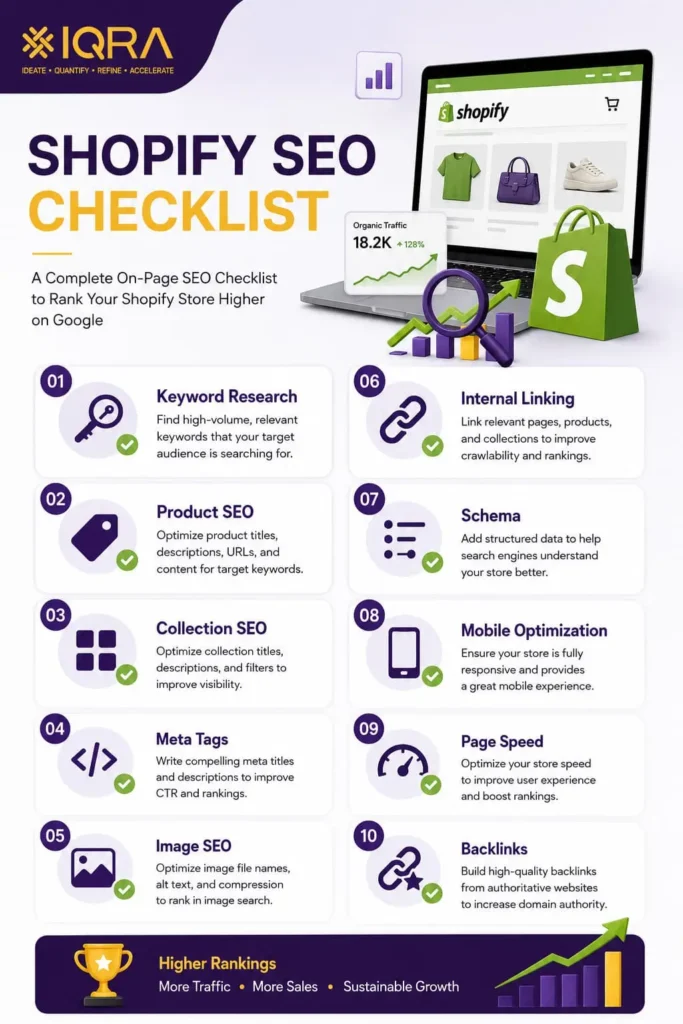
Technical SEO Checklist
Check each of the following parameters and get them correct one by one!
- Enable HTTPS for strong security
- Submit updated XML sitemap to Google Search Console
- Fix broken links and redirection errors
- Improve the Page loading speed
- Make sure it is mobile-friendly
For On-Page SEO
Follow the checklist below to do on-page SEO of your Shopify Website
- Check the meta titles and meta descriptions of all pages
- Use the proper descriptive headings
- Include the keywords naturally, don’t stuff
- Write the product description accurately
- Add internal links wherever necessary
Content Optimization Checklist
For the content part, check the following things
- Publish helpful and EEAT-friendly content
- Updated old content
- Respond to the customer’s query
- Optimise the images and alt text with reference to SEO
Off-Page SEO Checklist
As the name suggests, off page SEO, it is something we do outside of our website. Check the following checklist to do off-page SEO:
- Earn the backlinks from the reputed websites
- Try guest blogging within the same industry
- Encourage the brand mentions using Hashtags on various social media handles
- Maintain the consistency of posting on social media profiles.
Shopify SEO Optimization: Step-by-Step Guide
Following the stepwise procedure below, you can optimize the results of the search engine of your Shopify store.
Step 1 – Conduct Keyword Research
The first step is to identify the keywords through which customers are finding you online. The intent must be commercial. It should have keywords such as buy, purchase, get, online, offers, etc., and also add a few informational queries to drive traffic to your blog page and redirect them to your product page.
Step 2 – Optimize Your Shopify Store Structure
Try to keep the navigation as simple as you can and also put it into the proper collections. Users must reach their desired page in the minimum number of clicks.
Step 3 – Optimize Product Pages
For each product page, write unique descriptions; do not copy and paste what the manufacturers have written. Include the keywords, benefits or usage of that product and high-quality images as per the platform’s guidelines.
Step 4 – Optimize Collection Pages
Collection pages can also be called category pages. Make sure you have a description for each page with naturally placed keywords.
Step 5 – Improve Technical SEO
In the technical SEO part, you need to work on images, try to make sure they are compressed, remove unnecessary HTML spaces, fix the issues found in the crawler, and ensure all important pages are indexed.
Step 6 – Create SEO-Friendly Content
Regularly post blogs on topics such as shopping guides, fashion mantras, etc. You can also include the comparison articles when users have an option to choose from. Use relevant keywords in your blog’s content.
Step 7 – Build Quality Backlinks
Gain authority backlinks using various off-page activities such as guest posts, PRs, influencer marketing, collaborations, etc.
Shopify SEO Tips to Improve Rankings
Optimize Meta Titles and Descriptions
Create keyword-focused meta titles and meta descriptions. It must give the user the idea about the page.
Improve Site Speed
No one likes to see the buffering image on the screen; thus, improving the site’s loading speed is necessary. Use Page Speed Insights to check the loading speed.
Use SEO-Friendly URLs
Keep the URLs short, must have a keyword, and a hint about the cluster. Do not use any number in the URL.
Optimize Images and Alt Text
Give names to your image files and alt text properly to help search engines understand more about your images.
Strengthen Internal Linking
Apply internal linking to relevant product pages and collections with the blogs; it helps users discover the relevant content and improves page views.
Add Structured Data
Properly structured data helps crawlers and search engines to better crawl and understand your pages, and hence the search results also improve.
How to Rank Your Shopify Store Higher on Google
Focus on Search Intent
Understand the intent behind the search query, it can be informative, navigational, transactional or commercial.
Build Topical Authority
Creating clusters of related content based on your intent and build your expertise in the subject compared to writing random, isolated articles.
Improve Core Web Vitals
Improving core website vitals such as loading speed, visual stability, and responsiveness. It offers customers a smooth experience.
Earn High-Quality Backlinks
Instead of adding multiple low-quality links, focus on a few and authoritative backlinks to get more value.
Optimize for AI Search Results
To be a part of AI-powered search results, focus on writing concise and unique answers, use structured headings, include FAQs, and organize the information in a logical sequence.
Common Shopify SEO Mistakes to Avoid
Duplicate Content
Do not copy product descriptions across products pages or directly from the manufacturer, as duplicate or plagiarised content affects your ranking.
Thin Product Descriptions
Focus on providing practical details, accurate specifications, benefits, any instructions, pricing and shipping details instead of writing short and vague descriptions.
Missing Alt Text
Always add image alt text because it helps with better optimization and increases your reach, ensuring you don’t miss out on valuable traffic.
Poor Internal Linking
Poor internal linking creates invisible ‘orphan pages’ that users and search engines can’t find. This directly hurts your rankings and discoverability.
Ignoring Technical SEO
Technical issues like broken pages, crawl errors, and slow loading speeds can negatively impact your best content. Thus, always update them.
How to Measure Shopify SEO Progress
To begin with
First, connect Google Search Console and Google Analytics with your Shopify website. Then, establish baseline traffic numbers and monitor indexing status.
Essential SEO Tools
Make use of all the important SEO tools, including Google Search Console, Google Analytics, keyword research platforms, and site audit tools, to identify technical issues and improve your ranking.
Important Metrics to Track
Regularly monitor organic traffic, keyword rankings, click-through rate (CTR), impressions, conversions, bounce rate, and revenue generated from organic search.
Key Takeaways
Shopify SEO Success Checklist
- Research the right keywords that help in ranking
- Optimize products and collections
- Improve the technical performance of your site
- Publish valuable content consistently
- Build authoritative backlinks
- Track performance and refine your strategy.
Next Steps for Better Rankings
Shopify SEO is an ongoing process rather than a one-time task. Doing small, consistent improvements across content, technical health, and user experience can lead to significant gains in organic visibility and long-term ecommerce growth.
